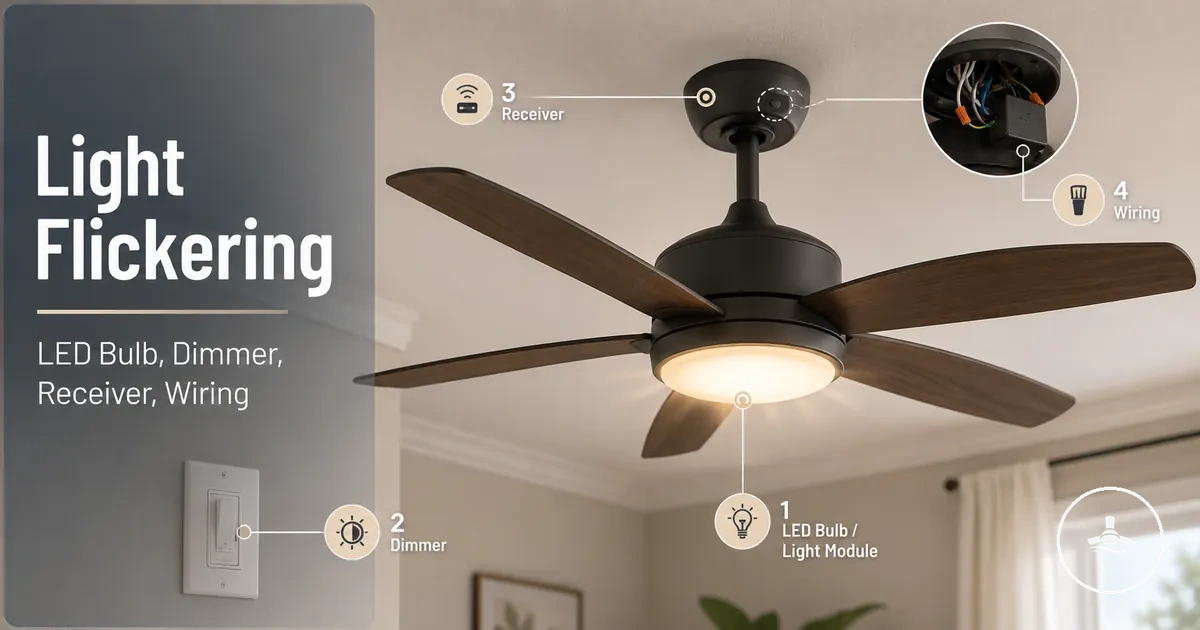
Ceiling Fan Light Flickering as a Troubleshooting Signal
Ceiling fan light flickering is an unstable or intermittent light output that can act as a diagnostic signal, not a single fixed fault. In a ceiling fan light, flickering may come from electrical supply instability, LED compatibility, dimmer control behaviour, wiring stability, a control module, or an internal component such as a capacitor. The same visible symptom can appear as pulsing, blinking, brief dimming, or irregular flashing, so the pattern should be read before a cause is assumed. A flicker that appears only with a certain bulb type may point toward compatibility, while flicker during switching or remote use may suggest a control-layer issue. A flicker that becomes frequent, spreads, or appears with other electrical symptoms may need a more cautious troubleshooting path.
The diagnostic flow should move from the simplest visible condition to the deeper system condition: bulb type, dimmable LED behaviour, dimmer control, remote receiver or smart control response, wiring stability, and then internal components. A loose bulb or incompatible LED may create local instability, while voltage fluctuation or a neutral connection issue may indicate a broader electrical supply condition. Control module behaviour can also create irregular flicker when the ceiling fan light changes mode, receives a signal, or modulates power. Capacitor or LED driver degradation may be considered when flickering persists after basic compatibility and control factors are ruled out. For broader category context, this troubleshooting page belongs within the larger ceiling fans with lights guide. The sections below separate each fault domain so the symptom can be interpreted without treating every flicker as the same problem.
What Ceiling Fan Light Flickering Indicates and How Flicker Patterns Relate to Different System Conditions and Fault Types
Ceiling fan light flickering is unstable or intermittent light output that can indicate changing conditions within a ceiling fan lighting system rather than a single fault. As explained in the ceiling fans with lights guide, flickering should be interpreted as a symptom pattern that may relate to electrical supply, LED driver behavior, load sensitivity, or another system condition. The way the ceiling fan light behaves often provides more diagnostic value than the presence of flickering alone. Intermittent flicker, continuous flicker, and changes linked to operating conditions may each point toward different diagnostic categories. Understanding the symptom pattern helps distinguish possible fault types before moving into detailed diagnosis.
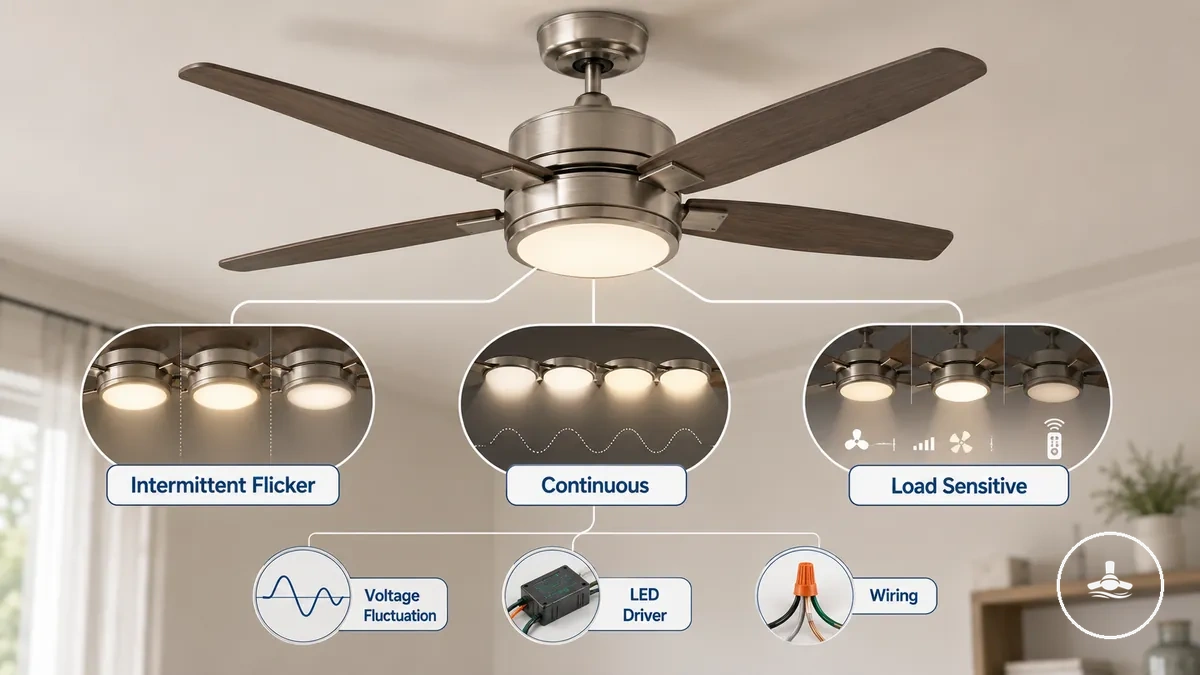
Different flicker patterns may suggest different system conditions, although no single pattern confirms a specific cause.
- Intermittent flicker: May occur occasionally and can be associated with load sensitivity, intermittent electrical conditions, or changing operating states.
- Continuous or pulsing flicker: May indicate an ongoing condition involving LED driver behavior, voltage fluctuation, or another persistent system characteristic.
- Load-sensitive flicker: Flickering that changes with brightness, fan operation, or control input may relate to dimmer response, a wiring issue, neutral instability, or interaction between connected components.
These classifications are intended to interpret flicker behavior rather than identify a definitive fault. The following sections examine each diagnostic category separately so the symptom pattern can be evaluated in the context of bulb compatibility, control systems, wiring, and internal components.
LED Bulb Compatibility Issues and Non-Dimmable LED Mismatch as a Common Cause of Ceiling Fan Light Flickering
LED compatibility describes how the bulb type, driver expectations, and fixture load work together in a ceiling fan light. As outlined in LED brightness and dimming, flicker behavior may occur when these elements are not compatible, even if the LED bulb is functioning normally. A driver mismatch can contribute to unstable light output because the electrical circuit and the bulb may respond differently under the same operating conditions. For this reason, ceiling fan light flickering may indicate a compatibility issue rather than a fault in the bulb itself.
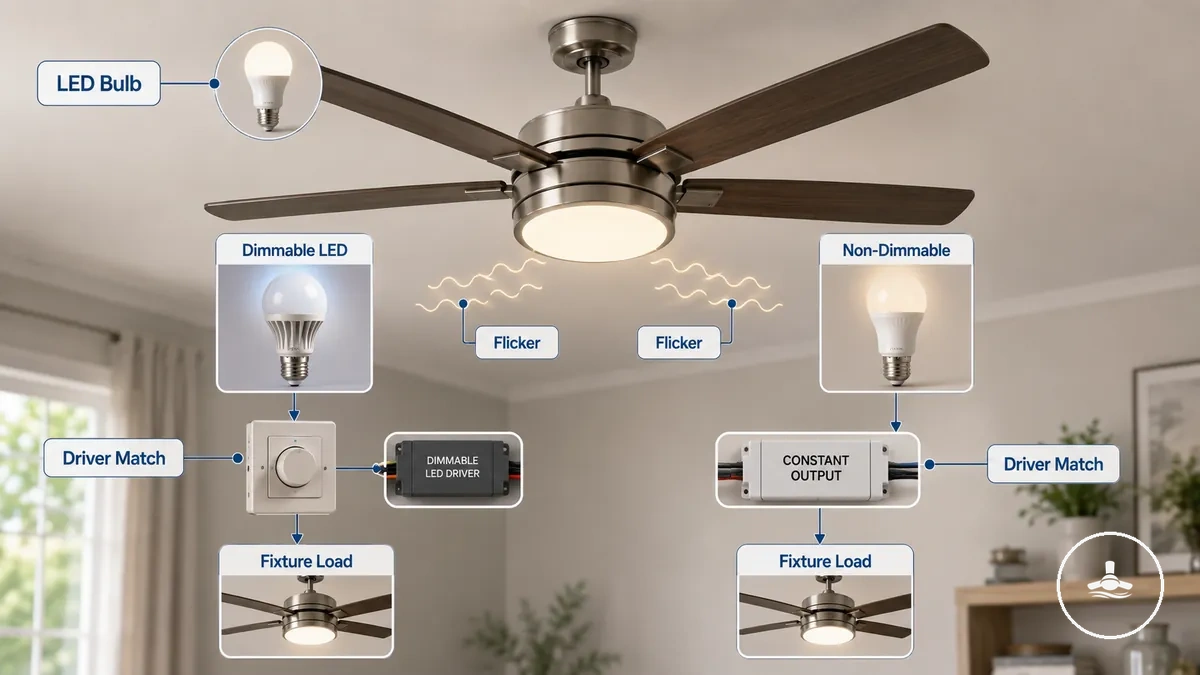
Dimmable LED and non-dimmable bulb designs are intended for different electrical conditions. A dimmable LED is designed to respond to brightness control, while a non-dimmable bulb is generally intended for a constant-output circuit. When bulb type, fixture load, and driver expectations do not align, the response curve may become unstable and flicker behavior can occur instead of steady illumination.
| Bulb Type | Operating Characteristic | Possible Flicker Behavior |
|---|---|---|
| Dimmable LED | Supports brightness control response | May flicker when driver mismatch or fixture load affects LED compatibility |
| Non-dimmable bulb | Designed for constant-output operation | May show unstable output if used in changing control conditions |
LED compatibility is best interpreted as the relationship between bulb type, driver behavior, fixture load, and the electrical circuit. A change in flicker behavior after replacing a bulb may suggest a compatibility mismatch, but the symptom should be considered alongside other diagnostic categories before attributing it to a single cause.
Dimmer Switch Incompatibility and Low-Load Dimming Behavior Causing Intermittent Flickering in Ceiling Fan Lights
Dimmer switch compatibility depends on how the control system interacts with the ceiling fan light, the electronic driver, and the connected lighting load. A compatibility issue may arise when the dimmer switch, load threshold, and LED response are not well matched, which can lead to flicker or unstable brightness. Unlike LED bulb compatibility issues, this type of flicker is associated with how the dimmer regulates power rather than with the bulb itself.
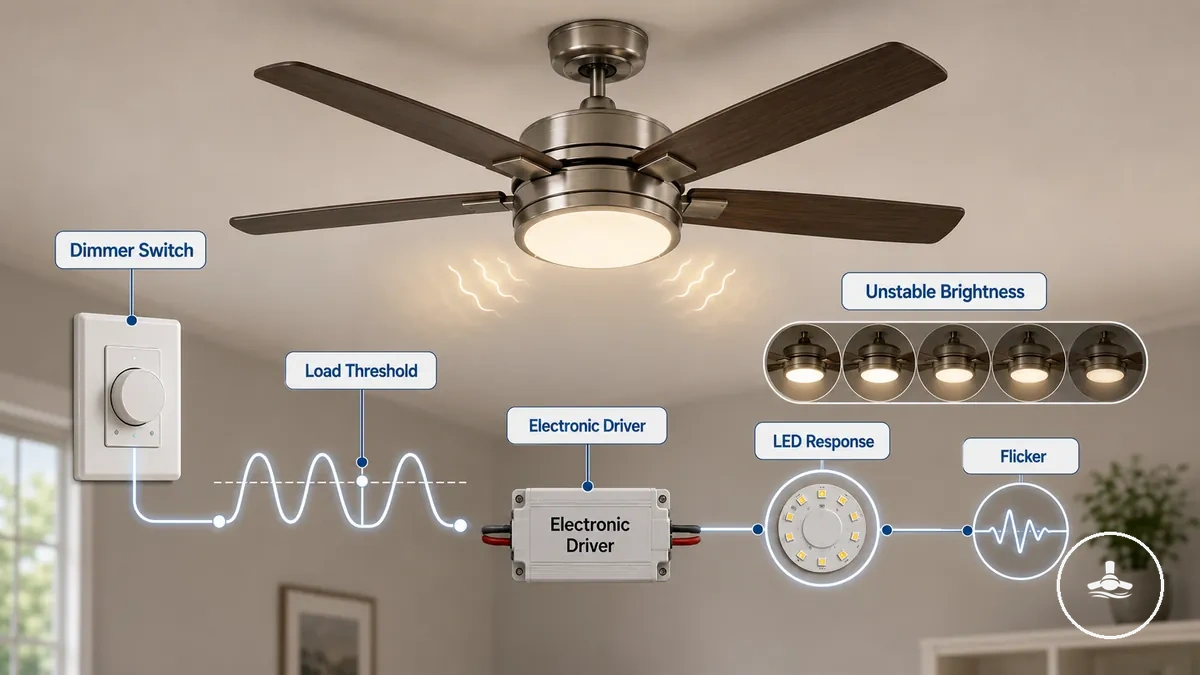
Low-load conditions and incompatible dimmer types can influence how an electronic driver responds to changing power levels. As described in LED brightness and dimming, LED response may vary according to dimmer type, load threshold, and driver characteristics. When these conditions are not compatible, the ceiling fan light may exhibit intermittent flicker, pulsing, or unstable brightness instead of a smooth lighting response.
| Flicker Source | Primary Condition | Typical Observation |
|---|---|---|
| LED compatibility | Bulb type, driver, and fixture load relationship | Flicker associated with bulb compatibility characteristics |
| Dimmer compatibility | Dimmer type, load threshold, and LED response | Flicker associated with brightness control or unstable dimming behavior |
Although both conditions can produce similar flicker patterns, they represent different compatibility issues. LED compatibility focuses on the relationship between the bulb and the lighting system, while dimmer switch compatibility focuses on the interaction between the control system, the electronic driver, and the electrical circuit. Observing when flicker occurs may help distinguish these categories without assuming a single underlying cause.
Remote Receiver and Smart Control Module Instability Leading to Intermittent or Irregular Ceiling Fan Light Flicker
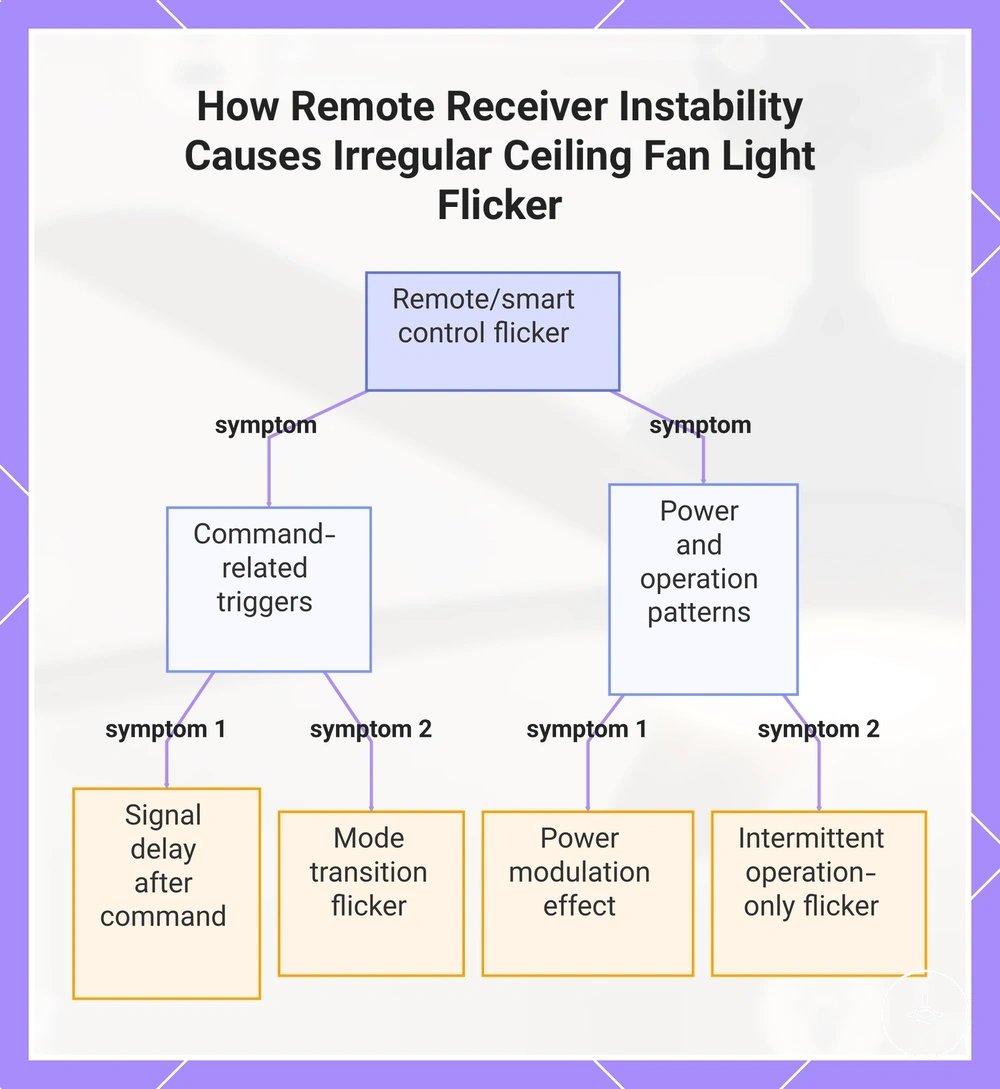
Remote receiver and smart control module behavior can influence how a ceiling fan light responds to switching commands and power modulation. A remote receiver or smart control system may introduce flicker irregularity when signal instability, delayed switching, or power modulation does not occur consistently. Unlike dimmer or wiring-related conditions, this type of intermittent flicker is associated with the control layer that communicates with the ceiling fan light and its electronic driver rather than with the lighting circuit alone.
When irregular flicker is linked to control actions or operating mode changes, the symptom pattern may help distinguish control-system behavior from other compatibility conditions.
- Signal delay: Flicker may occur after a remote receiver processes a switching command.
- Mode transition: Brief flicker irregularity can appear when the smart control changes between operating modes.
- Power modulation: Changing power delivery may cause intermittent light output if the electronic driver responds inconsistently.
- Intermittent behavior: Flicker that appears only during remote or smart control operation may suggest a control-related condition rather than a constant lighting issue.
This chart shows the symptom patterns that distinguish flicker caused by remote receiver or smart control module instability from other lighting issues.
Wiring Issues, Loose Electrical Connections, and Voltage Fluctuations Affecting Ceiling Fan Light Stability
When a ceiling fan light flickers without a clear bulb or control-system pattern, wiring instability may be an underlying electrical condition. A loose connection, an irregular neutral connection, or a voltage fluctuation within the electrical supply can contribute to intermittent flicker or changing light output. Understanding the wiring requirements for fan lights provides context for how electrical stability can influence ceiling fan light performance.
Wiring-related flicker often reflects changes within the electrical supply rather than fixture operation. The observed symptom may help distinguish different types of electrical instability, although no single pattern confirms a specific cause.
| Observed Symptom | Possible Electrical Condition |
|---|---|
| Intermittent flicker | Loose connection contributing to wiring instability |
| Irregular brightness changes | Voltage fluctuation within the electrical supply |
| Changing flicker under different household electrical conditions | Neutral connection or circuit behavior irregularity |
These symptom patterns should be considered separately from fixture-level conditions such as LED compatibility, dimmer behavior, or remote control operation because they relate to the electrical infrastructure supplying the ceiling fan light. If electrical stability remains uncertain, the electrical safety checks page provides additional context before further diagnosis.
Internal Electrical Components Such as Capacitors and LED Drivers Contributing to Flickering Behaviour in Ceiling Fan Lighting Systems
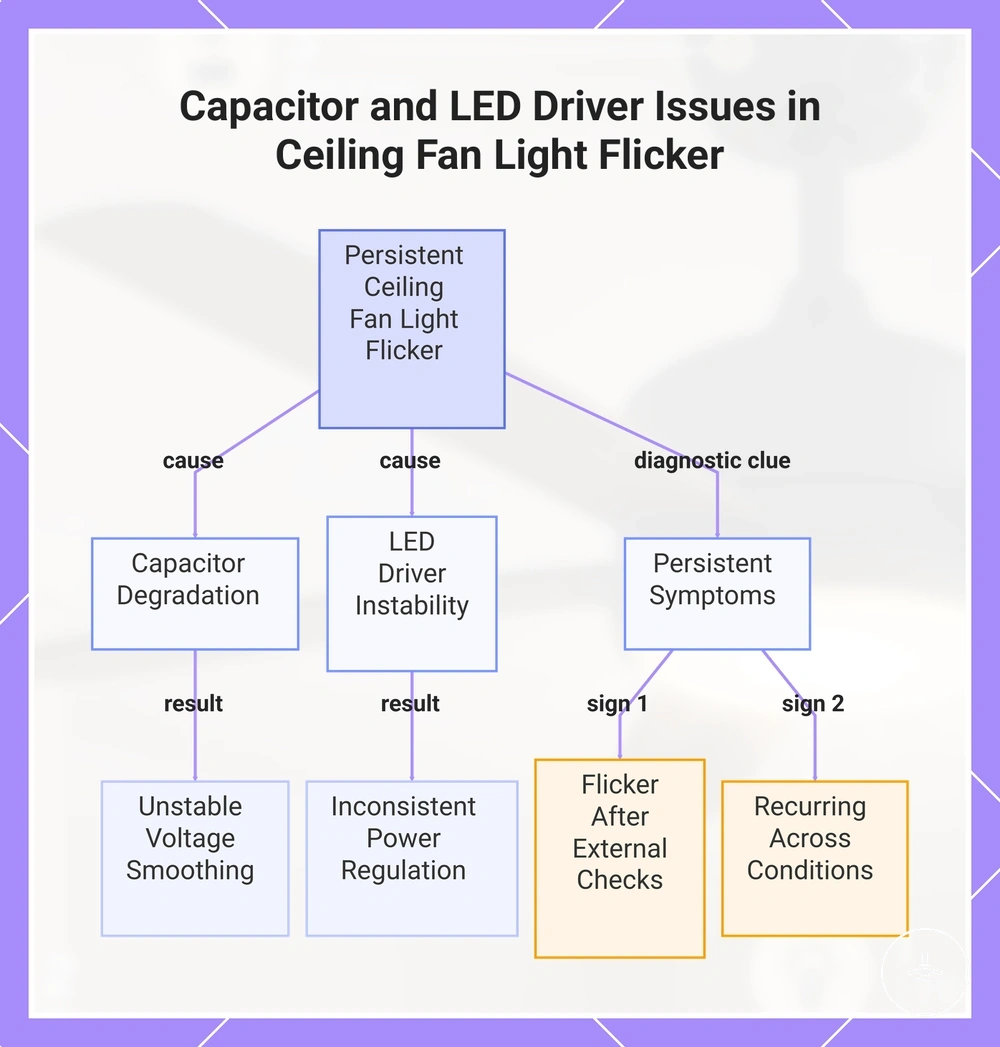
Internal electrical component degradation may contribute to persistent flicker when a ceiling fan light continues to behave irregularly after bulb, dimmer, control, and wiring conditions have been considered. A capacitor may affect voltage smoothing, while an LED driver may affect power regulation for the light output. If either internal component becomes unstable, the ceiling fan light may show recurring flicker rather than a pattern tied only to an external control or supply condition.
Persistent symptoms are the main diagnostic clue for possible internal failure, especially when flickering returns across different operating conditions. For broader related diagnosis, light not working troubleshooting can help connect recurring flicker with other lighting failure states.
- Persistent flicker: Flicker continues after common external conditions have been considered.
- Recurring symptoms: The same instability returns across repeated use.
- Driver instability: Light output may fluctuate if power regulation becomes inconsistent.
- Capacitor degradation: Voltage smoothing may become less stable when an internal capacitor weakens.
This chart explains how internal capacitor degradation and LED driver instability can cause persistent flicker in ceiling fan lights, along with the key diagnostic signs of internal failure.
Step-by-step Methods to Diagnose Ceiling Fan Light Flickering Based on Bulb, Control, Wiring, and Component Checks
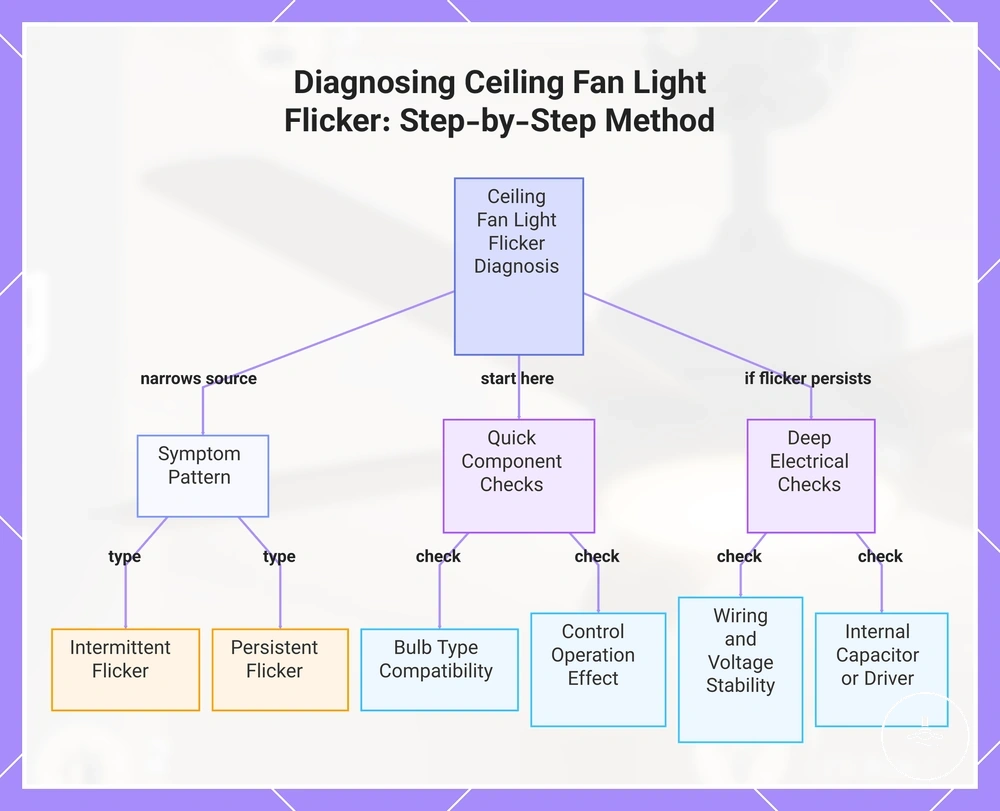
Diagnosing a ceiling fan light flicker is most effective when the diagnostic flow starts with the simplest potential causes and progresses toward more complex electrical conditions. Comparing the symptom pattern, such as intermittent versus persistent flicker, can help narrow the likely flicker source while maintaining a safety-first approach before considering more advanced troubleshooting steps.
Begin with the components that are easiest to evaluate before moving deeper into the lighting system.
- Check whether the bulb type and LED compatibility match the ceiling fan light.
- Observe whether the flicker changes with a dimmer, remote receiver, or other control operation.
- Determine whether the symptom pattern is intermittent or remains constant across normal use.
- Consider whether wiring conditions, voltage stability, or a neutral connection may be contributing to the flicker source.
- If external conditions do not explain the behavior, consider whether an internal capacitor or LED driver may be contributing to persistent flicker.
- If the light shows broader lighting faults in addition to flickering, continue with light not working troubleshooting for related diagnostic scenarios.
Moving through each failure domain separately helps distinguish bulb, control, wiring, and internal component conditions without assuming a single cause. Intermittent flicker may follow different diagnostic paths than constant or recurring flicker, so the symptom pattern should remain part of the evaluation throughout the process.
If uncertainty remains after progressing through the diagnostic flow, review the electrical safety checks before considering further diagnosis. This maintains a safety-first boundary while avoiding conclusions that are not supported by the observed symptom pattern.
This chart outlines a step-by-step diagnostic approach for ceiling fan light flicker, organized by symptom pattern, quick component checks, and deep electrical checks.
Frequently Asked Questions About Ceiling Fan Light Flickering Causes, Severity, and When Professional Repair Is Required
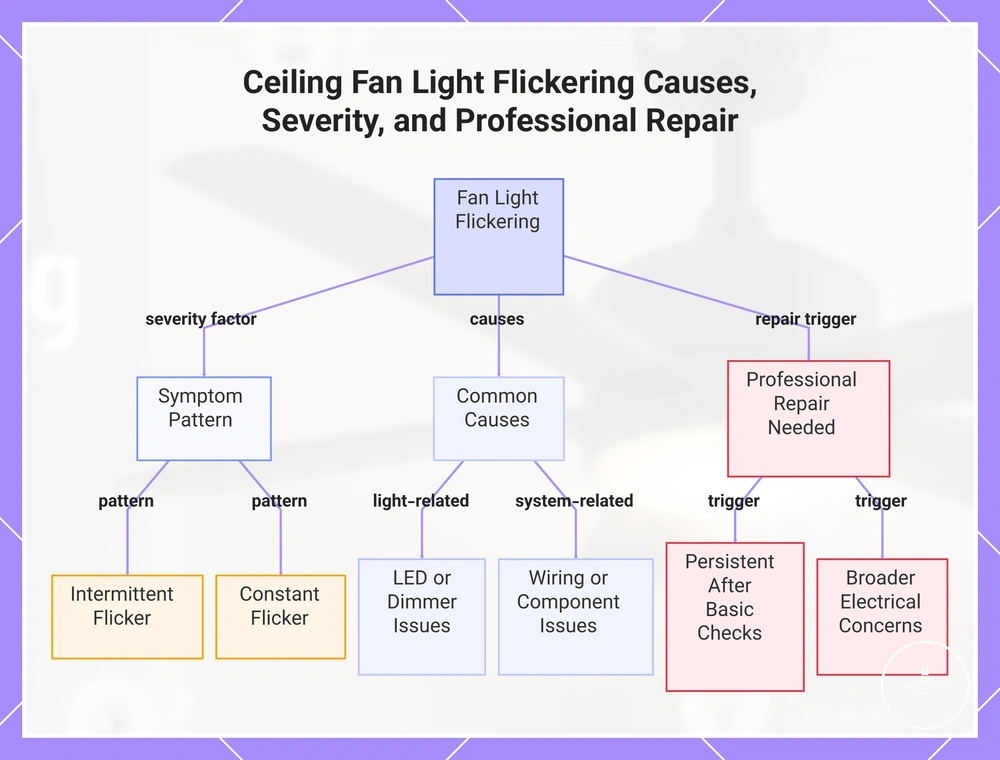
Is ceiling fan light flickering always serious? Not necessarily. Flicker severity depends on the symptom pattern and its possible cause. A ceiling fan light may flicker because of an LED issue, dimmer compatibility, control behaviour, wiring conditions, or internal components. For broader troubleshooting context, see the ceiling fans with lights guide.
When may professional repair be appropriate? If flickering persists after checking bulb compatibility, control settings, and other basic conditions, or if it occurs alongside broader electrical safety concerns or recurring lighting problems, further assessment may be appropriate. Intermittent flicker can indicate a different fault domain from constant flicker, so the symptom pattern should be interpreted before drawing conclusions. LED issues and dimmer compatibility may relate to the light itself, while persistent or widespread symptoms can indicate that additional diagnosis may be appropriate.
This chart explains the severity of ceiling fan light flickering based on symptom pattern, common causes, and conditions that require professional repair.