Best Ceiling Fans with Lights for Room-Based Selection
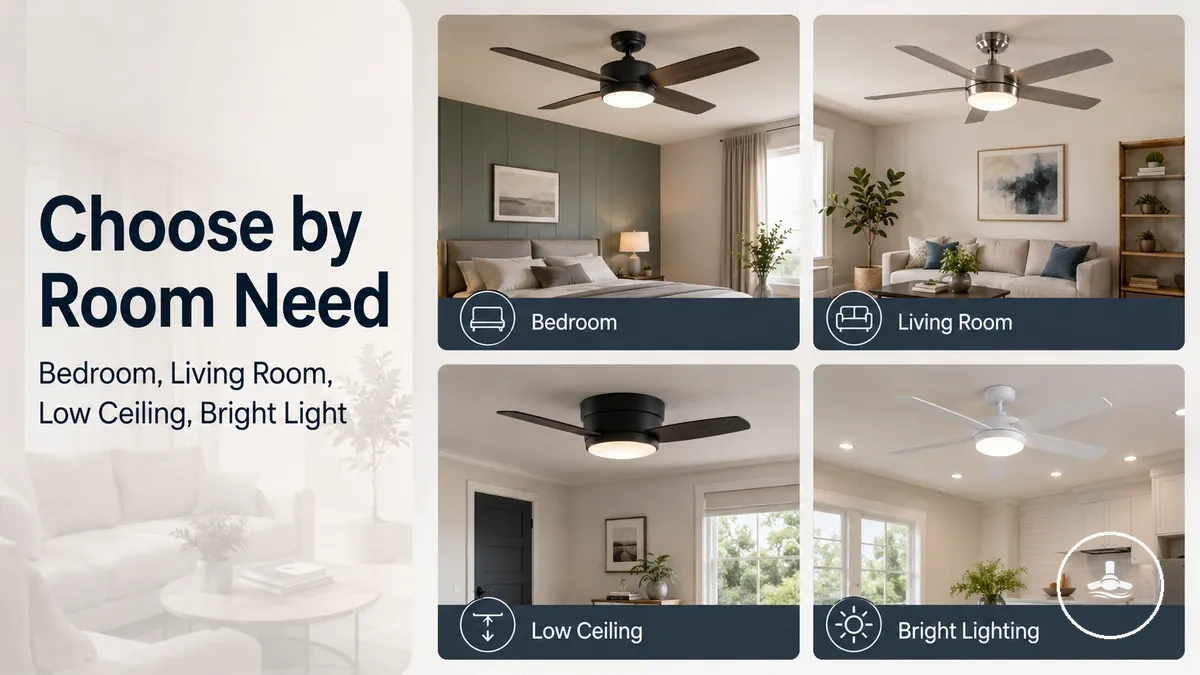
Ceiling fans with lights are room-led decision objects, not universal winners. The right ceiling fan with light depends on room need, feature priority, blade span, airflow, LED light expectations, ceiling fit, quiet operation, controls, and value.
A bedroom may need softer brightness, dimming, and quiet operation for comfort. A living room may need wider blade span, stronger airflow, and an LED light that supports shared use. A low ceiling may make a low profile or flush mount fan more suitable when ceiling height and clearance are limited. A large room may need more attention to airflow spread, remote control, smart control, and overall feature priority.
Use the recommendations as a selection frame, not as a fixed ranking for every room. For broader category context before comparing room-led options, see the ceiling fans with lights hub.
External price checks and partner details can vary, so product certainty should stay separate from decision support. A better-fit choice usually starts with the room condition first, then filters by lighting, airflow, controls, and value.
Ceiling Fans with Lights Selection Criteria
Selection criteria for ceiling fans with lights start with fit conditions, lighting, airflow, control type, and value. The right combination depends on room need because feature priority can change with ceiling height, comfort expectations, and everyday use.
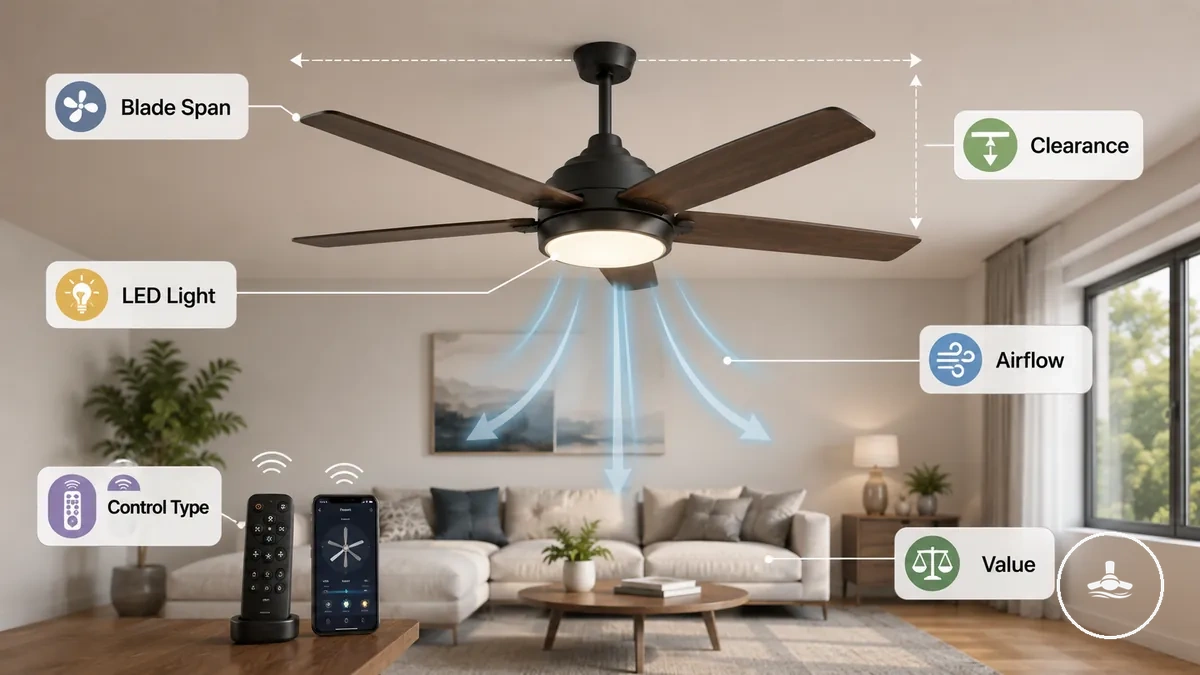
Ceiling Fans with Lights Selection Criteria organise the main decision factors before comparing room-specific recommendations. The table below groups each criterion with an acceptable condition and its likely selection impact so trade-offs are easier to compare.
| Criterion | What to check | Better fit when | Selection impact |
|---|---|---|---|
| Blade span | Room size and intended coverage | Blade span matches room need | Supports balanced airflow |
| Clearance | Ceiling height and mounting space | Low profile suits limited clearance | Improves fit conditions |
| Lighting | LED brightness, dimming, and colour temperature | Lighting suits the room's purpose | Supports lighting comfort |
| Airflow and quiet operation | Air movement and operating noise | Comfort is a higher priority | Balances airflow with quieter use |
| Control type | Remote, wall, or smart control | Convenience is preferred | Affects everyday operation |
| Value | Features compared with overall cost | Feature priority matches expected use | Supports informed comparison |
A bedroom may place greater emphasis on quiet operation and lighting control because comfort is often the main objective. A larger living area may give more weight to blade span and airflow for broader coverage. The order of these criteria can change with room need and fit conditions.
This criteria overview helps filter suitable options before detailed room-specific recommendations without replacing a fuller evaluation. For a broader review of fit checks and decision factors, continue with the buying checklist.
Room size and blade span fit
Room size narrows the blade span choices for a ceiling fan with light. A closer fit can support better coverage, airflow, and comfort, but the result still depends on the room condition rather than a universal size rule.
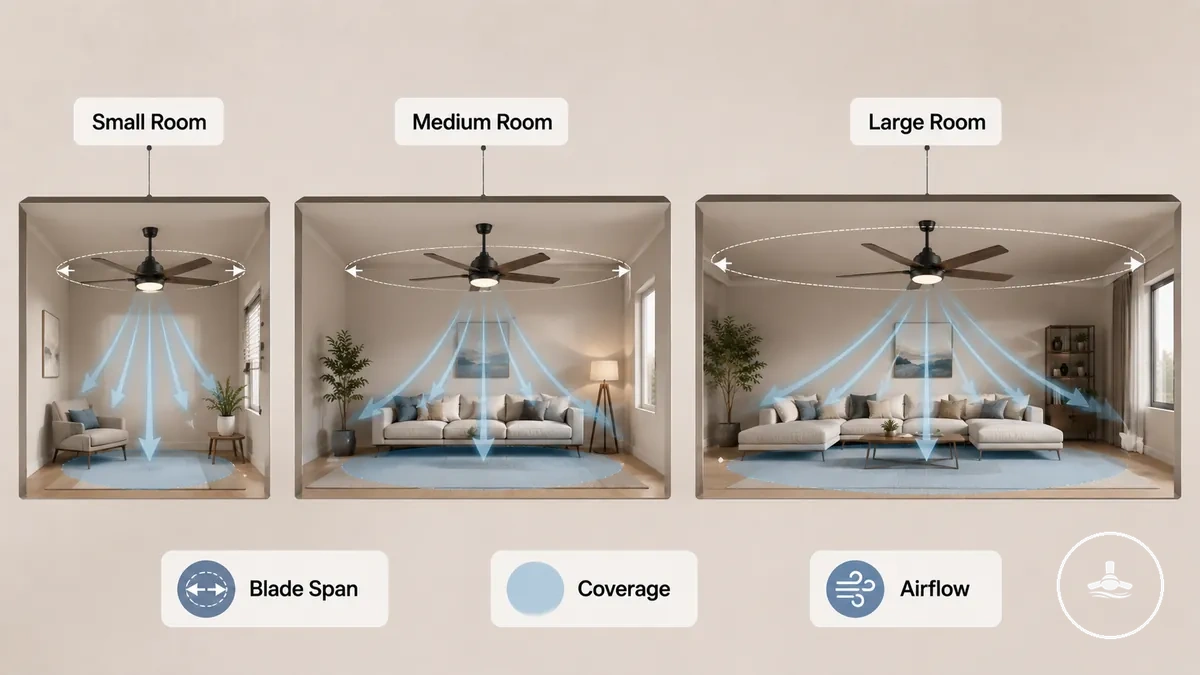
Room size and blade span fit become easier to compare when viewed as a local sizing filter.
- Small room: A compact blade span may provide suitable coverage while helping maintain comfort in a smaller area.
- Medium room: A balanced blade span can support even airflow when room coverage and everyday comfort carry similar priority.
- Large room: A wider blade span may improve coverage across a large room, although the final airflow result depends on layout and room conditions.
This local sizing filter narrows suitable options without replacing a dedicated room-size guide or making exact sizing promises.
Ceiling height and mounting clearance
Ceiling height and mounting clearance can filter out unsuitable ceiling fans with lights before feature comparison. A ceiling fan with light may fit better when the mount type, profile depth, blade clearance, and ceiling condition match the available space.
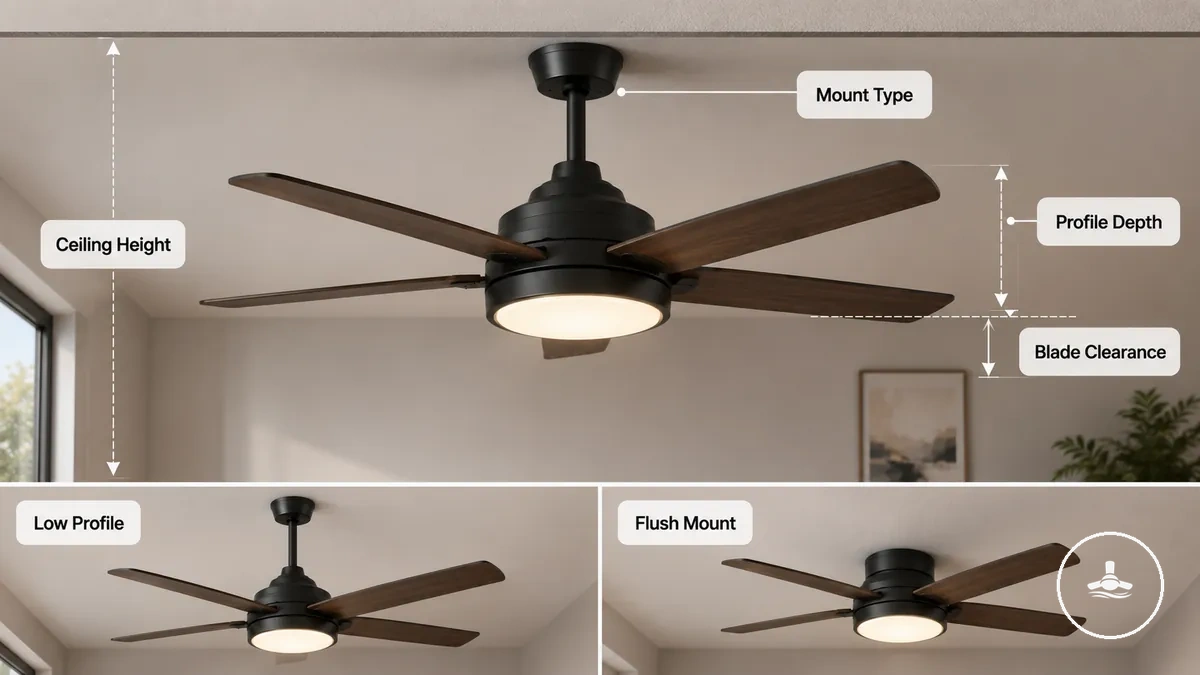
Ceiling height and mounting clearance are easier to assess when each visible fit condition is checked first.
- Mount type: Check whether a standard mount, low profile, or flush mount better matches the ceiling condition.
- Profile depth: Compare the overall depth of the ceiling fan with light with the available ceiling space.
- Blade clearance: Confirm that blade clearance appears suitable for the room condition rather than assuming every model fits.
- Light depth: Consider whether the light extends below the fan body, because this may affect overall mounting clearance.
- Ceiling condition: Use available clearance as a selection filter before comparing airflow, lighting, or other features.
This is a compatibility check to narrow suitable options, not an installation guide or a statement of guaranteed clearance.
Lighting brightness, colour, and dimming
Lighting performance changes how suitable a ceiling fan with light may be for different room uses. LED brightness, colour temperature, and dimming are key selection attributes because the right combination depends on room use rather than one fixed lighting level.
Compare the following lighting attributes to understand how brightness, colour temperature, and dimming may influence comfort and usability.
- LED brightness: Light output may suit everyday visibility or ambient light depending on room size, layout, and existing lighting.
- Colour temperature: Warm light can create softer lighting, while bright light may be preferred when greater visibility is needed.
- Dimming: A dimmable light can make it easier to adjust ambient light for changing activities and comfort preferences.
- Diffuser style: Diffuser style may affect how evenly light is distributed and how comfortable the lighting appears within the room.
Lighting quality should be considered as one selection attribute within the overall criteria for a ceiling fan with light. Whether the lighting is sufficient can depend on room size, room use, and any additional lighting already present.
Airflow strength and quiet operation
Airflow strength and quiet operation shape how comfortable a ceiling fan with light may feel in daily use. Stronger airflow can support room comfort, while quiet operation matters more when room sensitivity makes noise level noticeable.
Compare airflow and quietness through the conditions that affect use-case comfort.
- Airflow output: Higher air movement may suit rooms where circulation is the main comfort need.
- Speed control: A wider usable speed range can help adjust airflow for different comfort levels.
- Motor type: Motor behaviour may influence how smoothly the fan runs and how noticeable the noise level feels.
- Noise level: Lower operating noise may matter more in bedrooms or other spaces where room sensitivity is higher.
A ceiling fan with light should be judged by how its airflow, speed control, motor type, and quiet operation fit the room condition. Exact airflow and noise outcomes remain model-dependent, so the comfort decision should stay tied to room size, fan speed, and sensitivity to sound.
Remote, wall, and smart control needs
Remote, wall, and smart control needs affect how convenient a ceiling fan with light feels in daily use. The right control type depends on dimming access, speed access, scheduling needs, and any wiring dependency that may affect compatibility.
Use this comparison to decide which control type matches the use case before treating controls as a feature priority.
| Control type | Best use case | Watch for |
|---|---|---|
| Remote control | Convenient speed access and dimming access from within the room | Remote availability and control range may vary by model |
| Wall control | Fixed control access where a wall position suits daily use | Wiring dependency may affect whether this option is suitable |
| Smart control | Scheduling, app control, or voice control when supported | Compatibility can depend on the fan, setup, and home control system |
Wall control and smart control should be treated as conditional choices rather than assumed upgrades. A ceiling fan with light may need a specific setup for those controls, so compare convenience with compatibility before deciding.
Best Ceiling Fans with Lights Overall
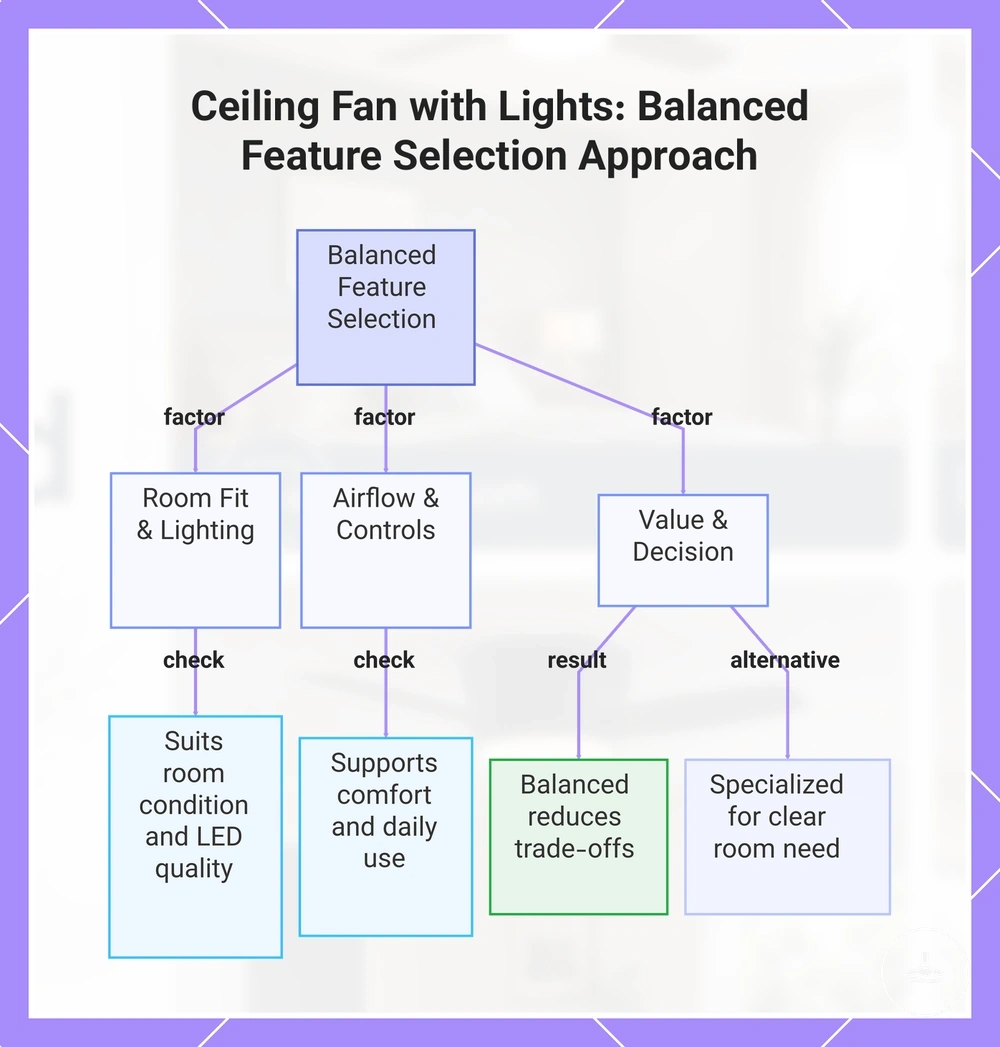
Overall, the strongest selection profile for ceiling fans with lights is a balanced feature mix rather than a single product choice. A ceiling fan with light is more useful for a broad shortlist when fit, lighting, airflow, controls, and value all support room suitability without relying on one extreme feature.
Use the summary below to judge whether an option has balanced shortlist relevance before comparing room-specific needs.
- Fit: The fan should suit the room condition before decorative or advanced features become important.
- Lighting: LED light quality should match the expected room use without assuming it replaces every other light source.
- Airflow: Air movement should support comfort for the room rather than focus only on maximum output.
- Controls: Remote, wall, or smart controls should improve daily use when the setup supports them.
- Value: The feature set should make sense for the intended use instead of adding features that do not affect the decision.
For general buyers, balanced performance may matter more than a feature-extreme option because it can reduce trade-offs across fit, lighting, airflow, controls, and value. A specialized feature priority may matter more when the room has a clear need, such as stronger airflow, softer lighting, or more convenient control access.
This chart outlines the key factors for evaluating a ceiling fan with lights, focusing on balanced features and the choice between general performance and specialized priorities.
Best Ceiling Fans with Lights for Bedrooms
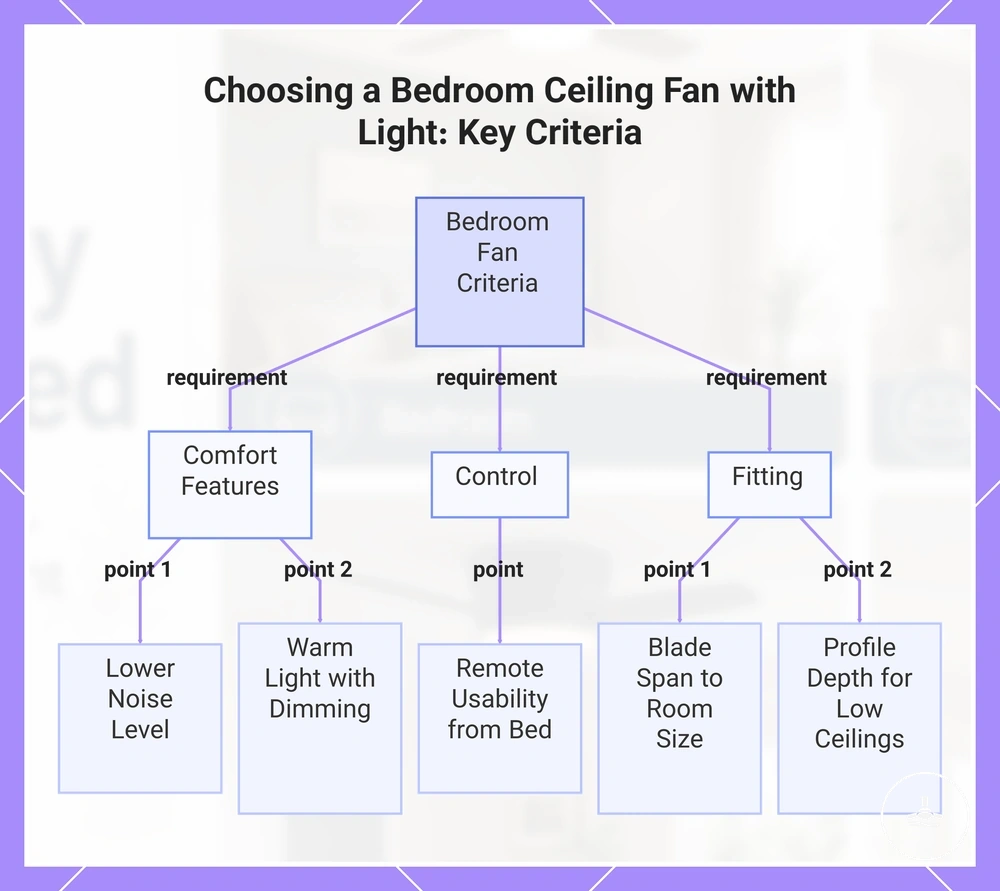
Bedroom-suitable ceiling fans with lights usually need quiet comfort, soft lighting, and practical control more than maximum output. A ceiling fan with light may fit a bedroom better when low-speed airflow, dimming, warm light, blade span, and remote control match the sleeping area.
Noise level and low-speed airflow matter because bedroom comfort often depends on gentle air movement without distracting operation. A model that offers usable lower speeds may suit night-time use better than one focused only on stronger airflow.
Use these bedroom criteria to filter options before comparing more detailed recommendations.
- Quiet comfort: Prioritise lower noise level when the bedroom is sensitive to sound.
- Soft lighting: Warm light and dimming can support a calmer bedroom setting when available.
- Remote control: Remote control can improve night-time usability because speed access and light control are easier from the bed.
- Blade span: Match blade span to the bedroom size instead of assuming every bedroom fan needs the same coverage.
- Low ceiling fit: A low ceiling may make profile depth and clearance more important than extra features.
For a deeper bedroom-focused comparison after these criteria are applied, continue with bedroom ceiling fans with lights.
This chart summarizes the essential criteria for selecting a ceiling fan with light suitable for a bedroom, focusing on comfort, control, and fitting factors.
Best Ceiling Fans with Lights for Living Rooms
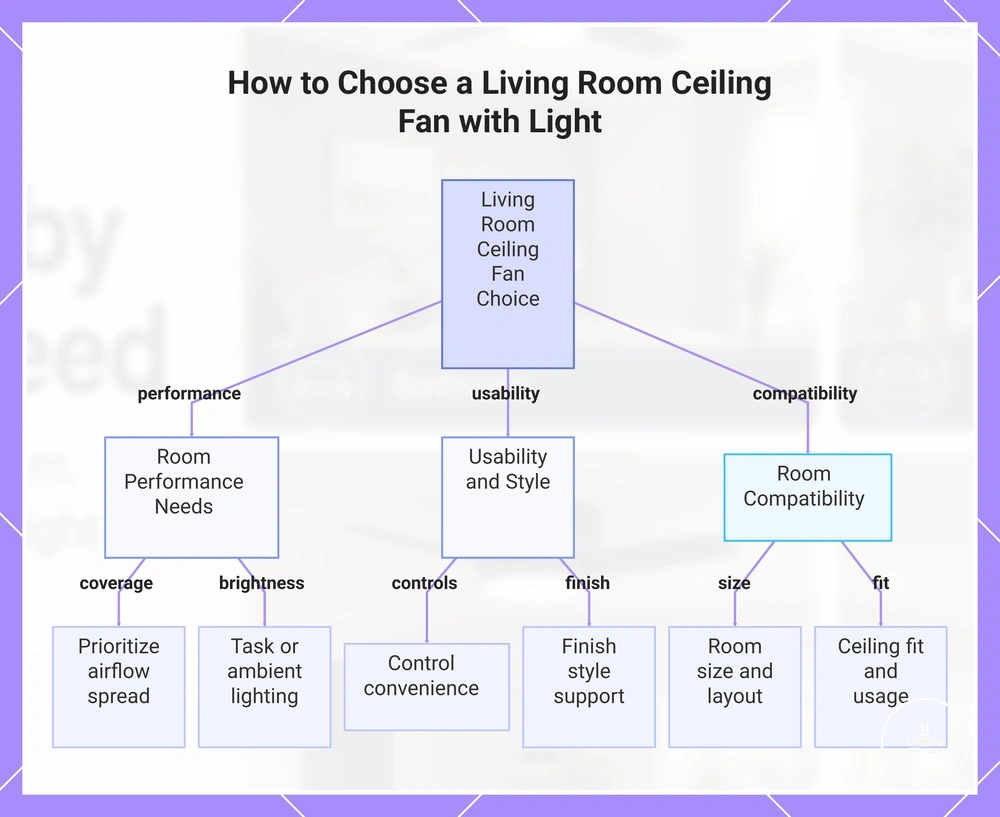
Living-room ceiling fans with lights should usually be chosen for coverage, brightness, and visible fit within a shared room. A ceiling fan with light may suit a living room better when blade span, airflow spread, LED brightness, control convenience, and finish style match the room condition.
Blade span and airflow spread matter because a living room often needs coverage across a wider or more open area than a bedroom. A wider airflow pattern may be more useful when the seating area is broad, but the final result still depends on room size and layout.
Use these living-room criteria to filter options before comparing detailed recommendations.
- Coverage: Prioritise airflow spread when the living room is open or shared by several people.
- Brightness: LED brightness may matter more when the room needs task lighting, while ambient lighting may suit softer shared-space use.
- Controls: Control convenience can improve daily use when fan speed and lighting are adjusted often.
- Finish style: Finish style should support the visible room setting without becoming more important than fit or performance.
- Room condition: Match the ceiling fan with light to the living room’s size, ceiling fit, and expected use before treating it as a recommendation.
For a deeper room-specific comparison after these criteria are applied, continue with living room ceiling fans with lights.
This chart outlines the key criteria for selecting a ceiling fan with light for a living room, including performance, usability, and room compatibility.
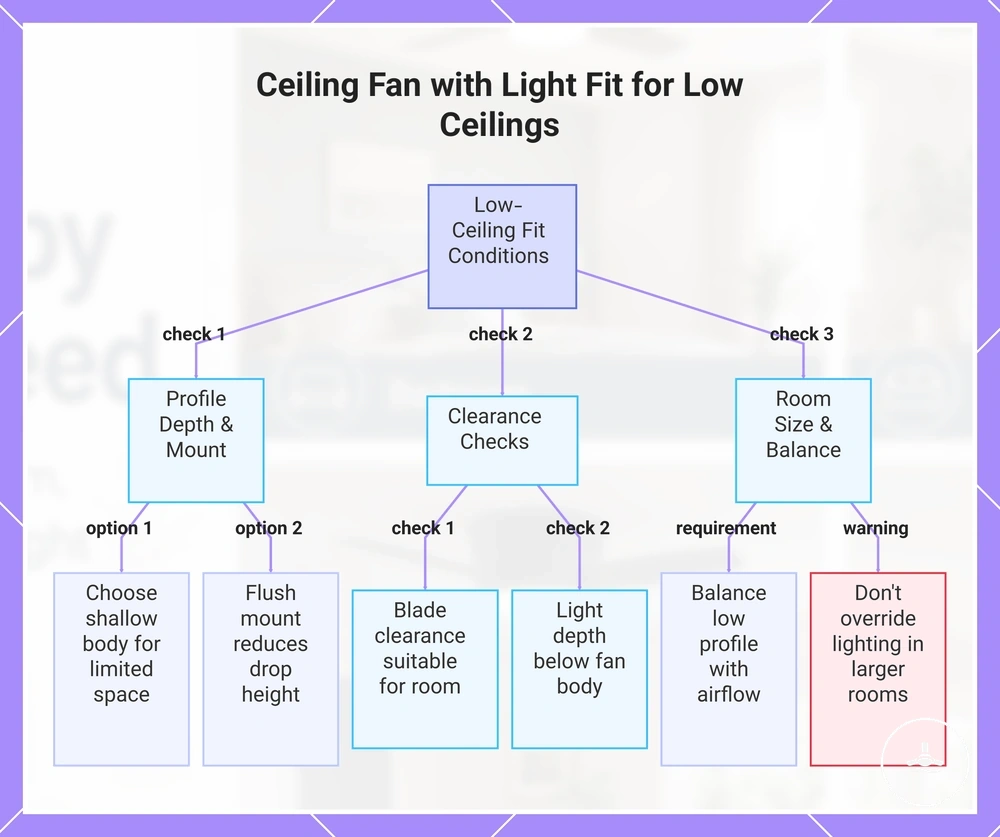
Best Ceiling Fans with Lights for Low Ceilings
Low-ceiling ceiling fans with lights should be filtered first by profile depth and clearance. A ceiling fan with light may be more suitable when the low profile body, blade clearance, and light depth match the low ceiling condition without assuming fit for every room.
Use this low-ceiling checklist to verify the main fit conditions before comparing style or extra features.
- Profile depth: Choose a shallow body when the available ceiling space is limited.
- Flush mount: A flush mount or close-to-ceiling fan may suit a low ceiling better when drop height is the main constraint.
- Blade clearance: Check that blade clearance appears suitable for the room condition before prioritising other features.
- Light depth: Consider whether the light extends below the fan body and affects the usable clearance.
- Room size: Do not let low profile design override airflow and lighting requirements in a larger room.
Low profile fit should be balanced against airflow and lighting requirements because comfort still depends on room size and use. This is a selection check, not an installation guarantee or electrical setup guide.
This checklist chart shows the key fit conditions to verify before selecting a ceiling fan with light for a low ceiling.
Best Ceiling Fans with Lights for Large Rooms
Large-room ceiling fans with lights should be chosen for coverage and usable brightness together. A ceiling fan with light may suit a large room better when blade span, motor strength, airflow distribution, LED output, and control range match the room layout and ceiling height.
Use this comparison to judge the main large-room factors before treating a model as suitable.
| Large-room factor | What it affects | Selection cue |
|---|---|---|
| Blade span | Wide coverage across the room | Choose a span that matches the large room condition without assuming exact area coverage. |
| Airflow spread | Air movement across seating or activity zones | Prioritise airflow distribution when comfort needs to reach more than one part of the room. |
| LED output | Usable brightness for shared space | Check whether the light supports the room use without assuming it replaces all lighting. |
| Control range | Convenience across a bigger room | Remote, wall, or smart control may matter more when the fan is used from different positions. |
| Layout | Coverage and lighting consistency | Open-plan space may need more cautious expectations because layout can affect airflow and brightness. |
Blade span, airflow distribution, motor strength, and LED output should work together because large-room comfort depends on more than fan size alone. In open-plan layouts, coverage and usable brightness can vary by room layout, ceiling height, and model design, so avoid treating one fan light as a fixed solution for every large room.
Best Ceiling Fans with Lights by Feature Priority
Feature priority should guide the shortlist after room fit has already narrowed the options. A ceiling fan with light may be a better match when its main feature supports the use case without creating a larger trade-off in airflow, LED lighting, remote control, or smart control.
Use this comparison to decide which priority feature should shape the final shortlist. The table compares supporting attributes, likely trade-offs, and better-fit conditions without ranking products.
| Priority | Supporting attributes | Trade-off | Better fit when |
|---|---|---|---|
| Quiet airflow | Quietness, speed range, motor behavior | Maximum airflow may matter less than lower noise | Room sensitivity makes noise level more noticeable |
| Bright LED lighting | LED lighting, brightness, dimming, light spread | Stronger light may not suit every ambient use case | Visibility is more important than soft background light |
| Remote control | Speed access, dimming access, convenience | Control convenience depends on the model and daily habits | Frequent adjustment from within the room is useful |
| Smart control | App control, scheduling, compatibility | Smart control may depend on setup and supported features | Scheduling or connected control supports the use case |
Quietness and airflow create the clearest comfort trade-off. A lower-noise ceiling fan with light may suit sensitive rooms, but the airflow still needs to support the room condition.
LED lighting and controls change usability in a different way. Brighter LED lighting may suit visibility-focused use, while remote control or smart control may matter more when convenience, scheduling, or access changes daily operation.
Choose the feature priority that solves the strongest use case after fit, lighting, airflow, and control conditions are already acceptable.
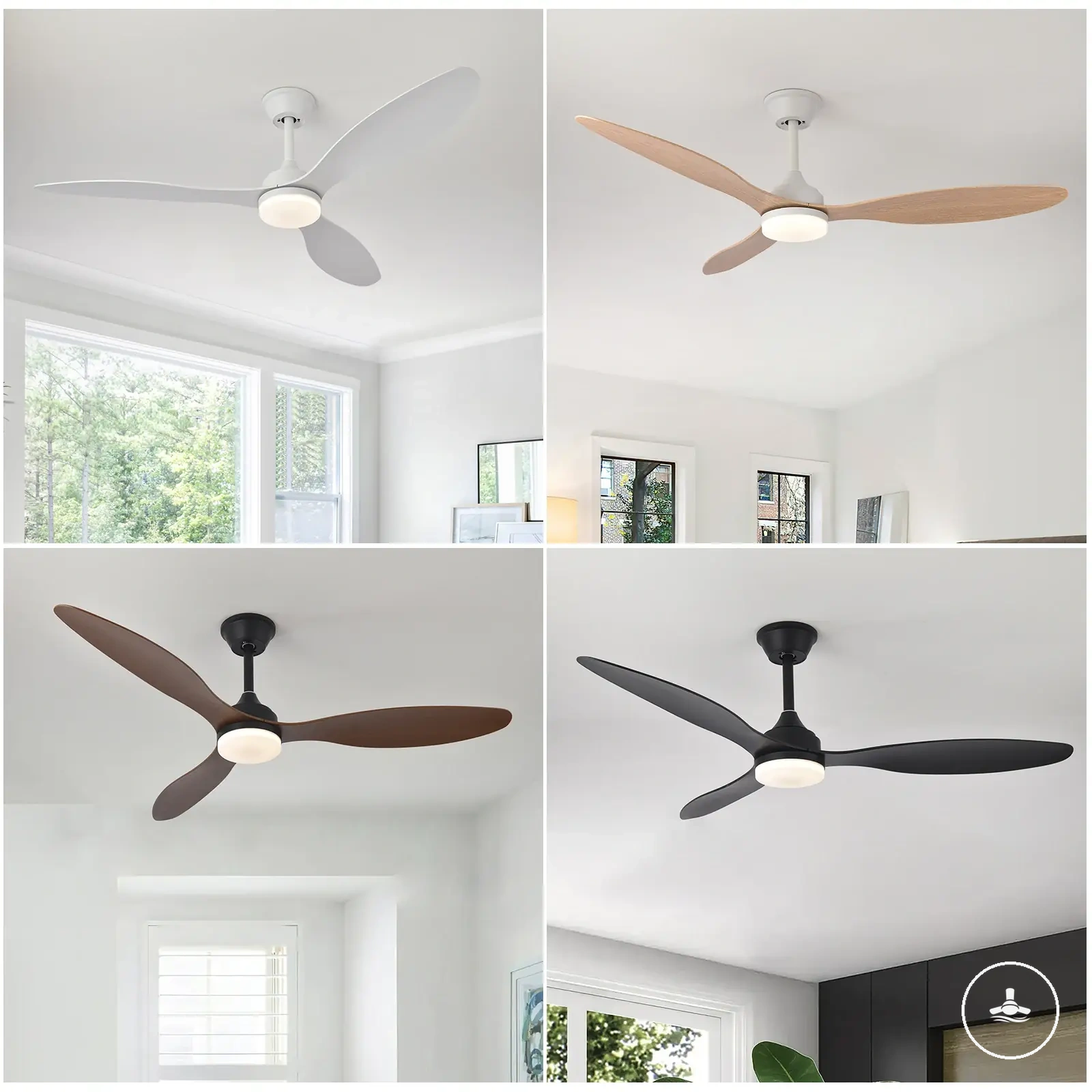
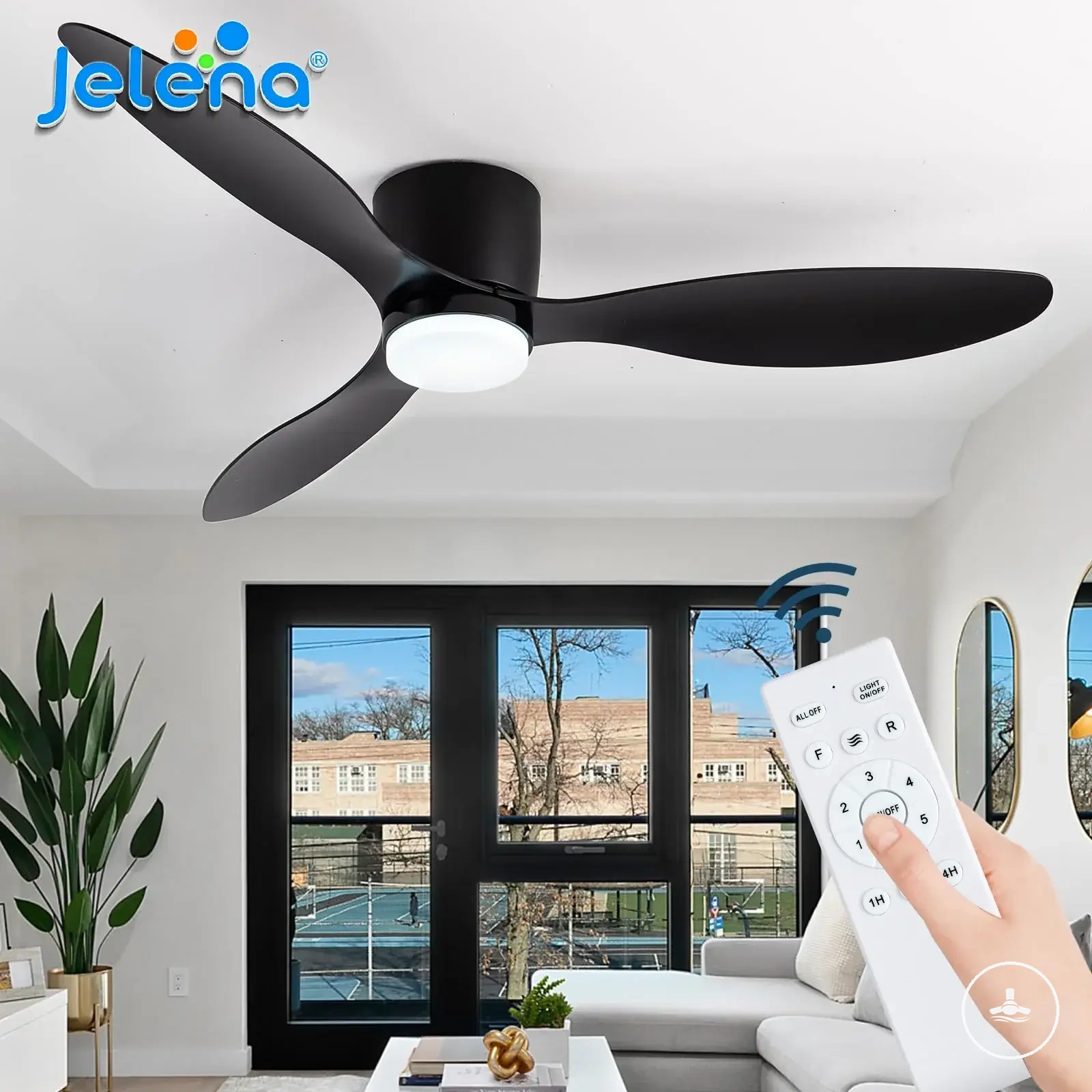
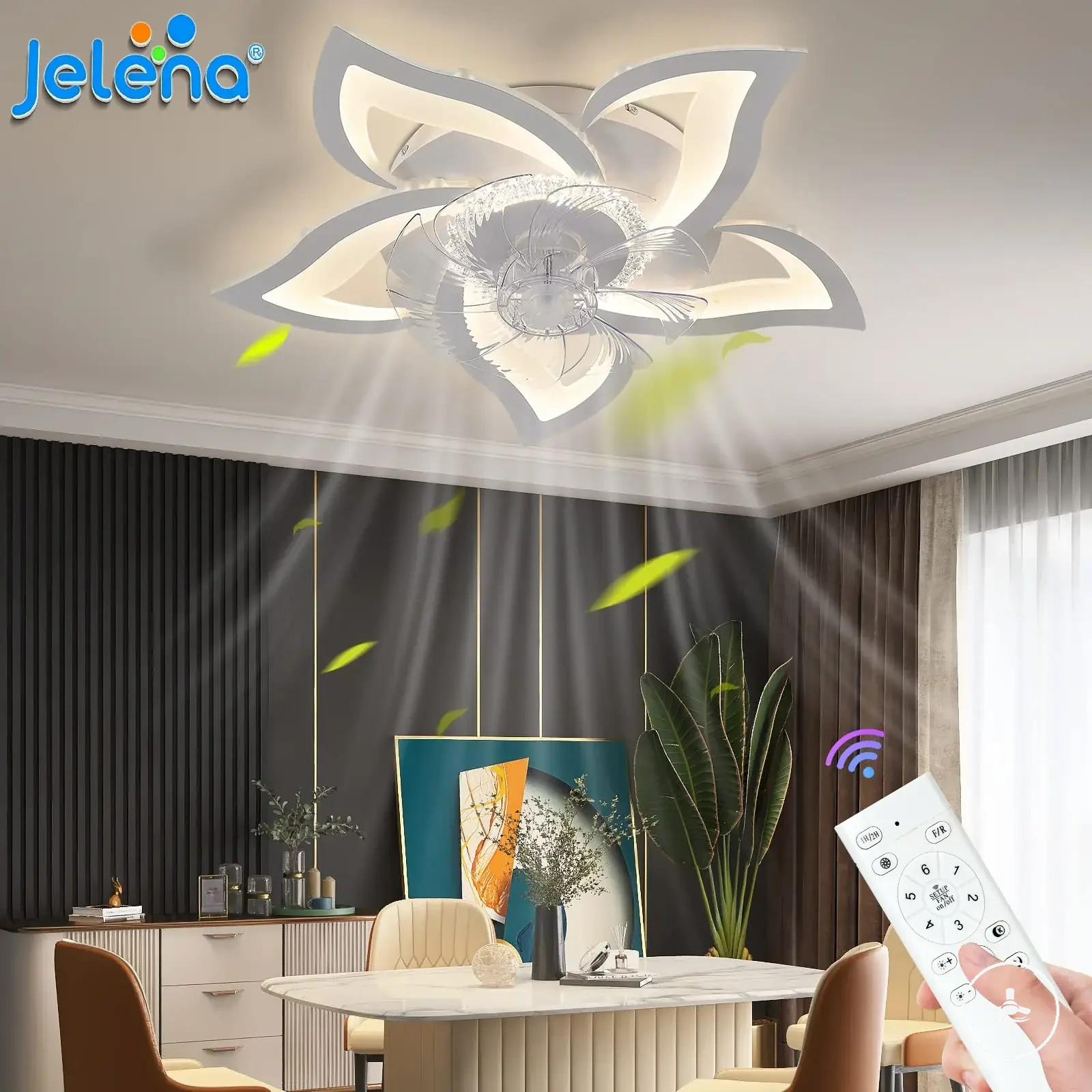
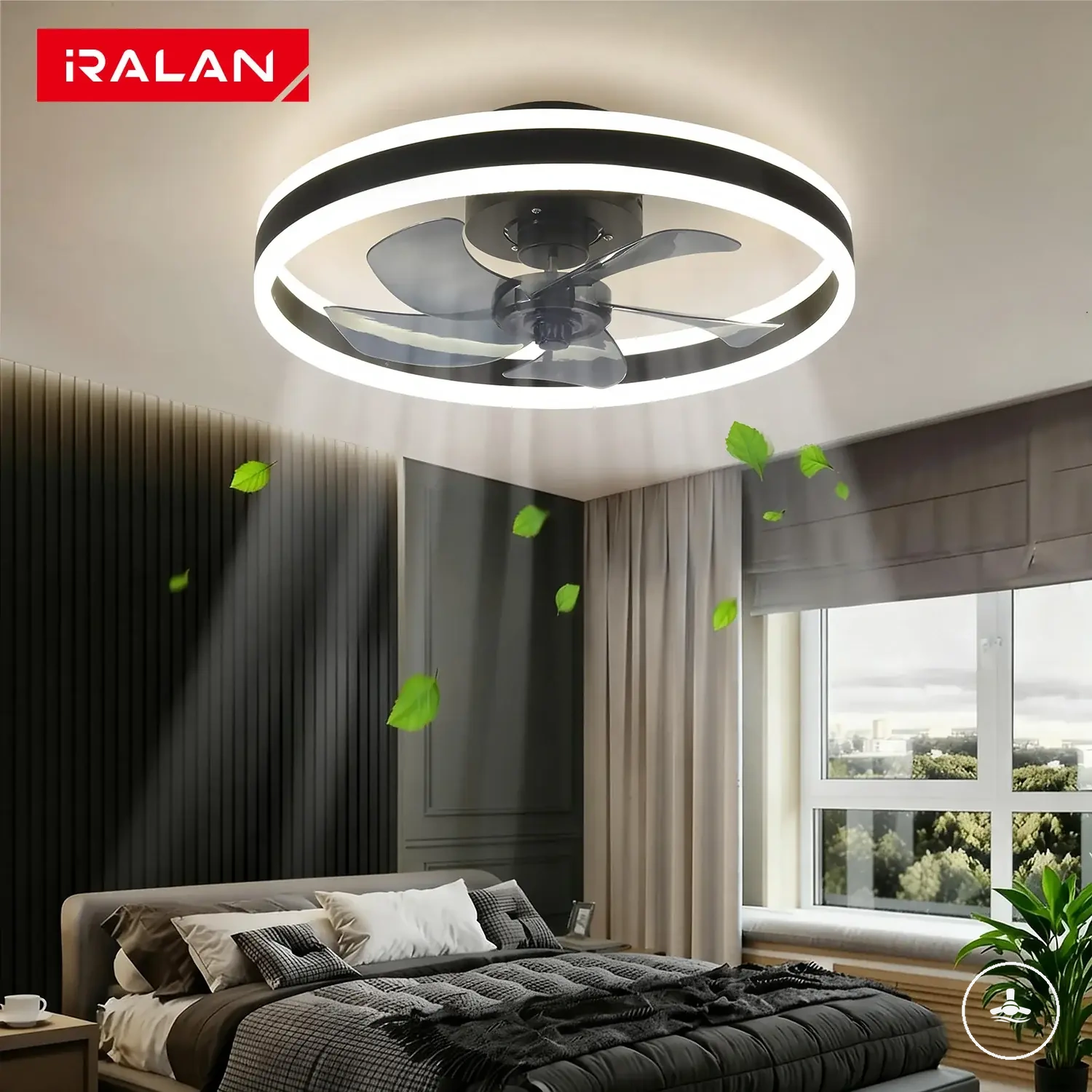
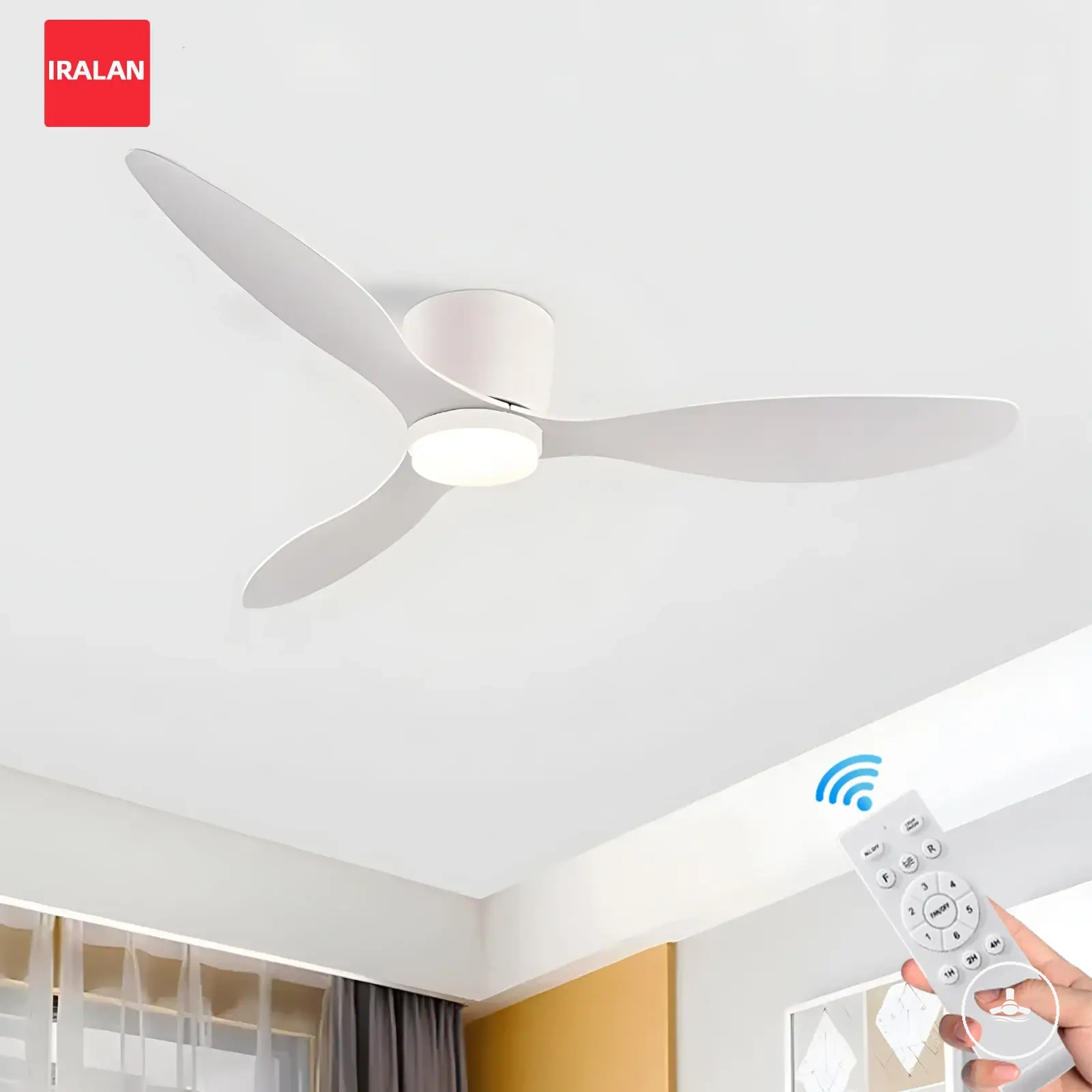
The products below are useful examples for comparing available options. Before buying, check that the compatibility criteria, key features, and product details match your needs.
Quiet airflow priority
Quiet airflow should become the dominant feature priority when room sensitivity makes fan noise more important than maximum airflow. A ceiling fan with light may be a better match when gentle airflow supports comfort without making the noise level distracting.
Use these quiet airflow factors to organise the selection conditions.
- Motor behaviour: Smoother operation may support lower-noise airflow when the room is sensitive to sound.
- Speed settings: Usable lower speeds can help balance gentle airflow with comfort during quiet-use periods.
- Blade balance: Better blade balance may reduce unwanted movement or noise that affects comfort.
- Room sensitivity: Quietness should override other feature priorities when noise level is more noticeable than extra output.
In quiet-use rooms, motor behaviour, speed settings, and blade balance can affect whether quiet airflow feels comfortable. Noise expectations should remain model-dependent because a quiet fan may not perform equally across all speeds.
Bright LED lighting priority
LED lighting should become the dominant feature priority when room use depends more on light quality than on quiet operation or control features. A ceiling fan with light may be a better match when its LED lighting supports the intended task, ambient, or mixed lighting condition.
Use these LED lighting factors to compare suitability.
- LED output: Higher LED output may be more suitable when task lighting is the main priority.
- Colour setting: The preferred colour setting depends on whether the room is used for focused activities, relaxation, or a combination of both.
- Dimming range: A wider dimming range can make it easier to adjust lighting for changing room conditions and comfort preferences.
- Light spread: More even light spread may improve overall usability, although separate lighting may still be useful in some rooms.
When task lighting, ambient lighting, or mixed lighting drives the decision, LED output, colour setting, dimming range, and light spread become the key selection criteria. The suitability of a ceiling fan with light still depends on the room condition, so integrated LED lighting may not replace every other light source.
Remote and smart control priority
Control convenience should become the dominant feature priority when quick access to fan settings matters more than lighting or airflow differences. A ceiling fan with light may be a better match when the preferred control method supports everyday use and the intended setup.
Use this comparison to understand how remote, wall, and smart controls differ.
| Control method | Convenience gain | Compatibility check |
|---|---|---|
| Remote control | Easy speed access and light control from within the room | Availability and supported functions may vary by model. |
| Wall control | Fixed access for everyday operation | Suitability may depend on the existing wiring condition and setup. |
| Smart control | App control, scheduling, and voice support when available | Compatibility depends on supported features and the home setup. |
When control convenience is the main decision factor, compare remote control, wall control, and smart control by their speed access, light control, scheduling, and compatibility. Control convenience should complement room fit because wiring condition and supported features may affect the final choice.
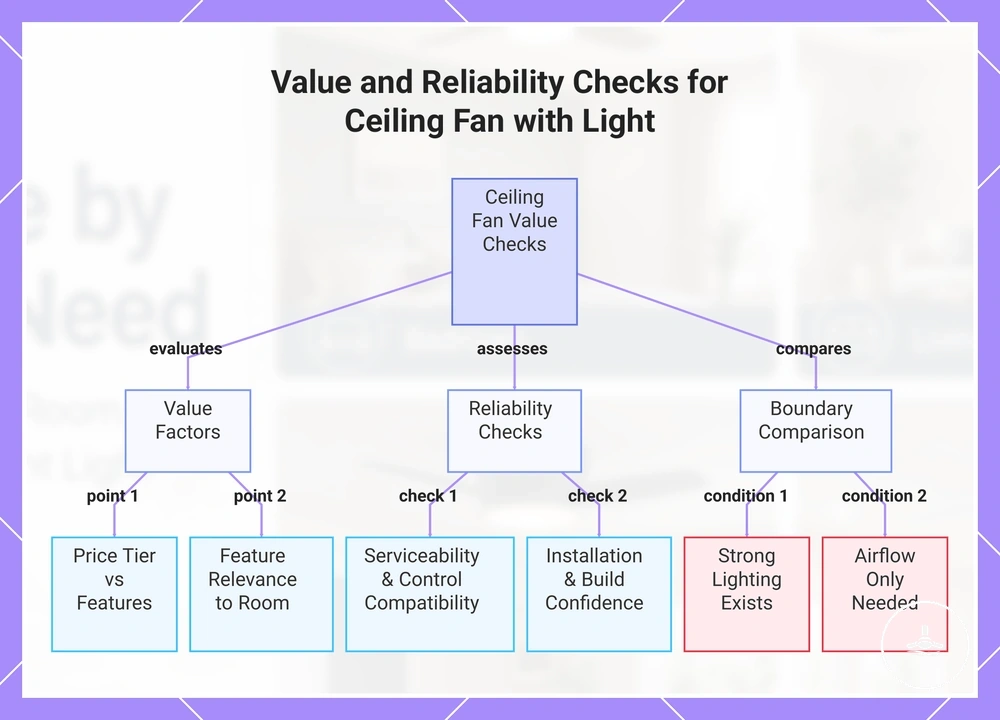
Value and Reliability Checks Before Choosing
Value and reliability checks should confirm that a ceiling fan with light fits the room and has features that are useful for the final decision. A higher price tier may be easier to justify when feature relevance, build confidence, control compatibility, and installation needs match the room condition.
Use this mini-checklist before moving to an external purchase destination. Each check should connect the feature set to a value condition rather than only comparing price.
- Price tier: Compare the price level with the features that are actually useful for the room.
- Feature relevance: Give more weight to lighting, airflow, or controls only when they support the use case.
- Serviceability: Check whether LED or light-kit serviceability affects long-term confidence.
- Control compatibility: Confirm that remote, wall, or smart controls suit the expected setup.
- Installation needs: Consider whether fit condition and installation needs may affect the final decision.
- Reliability: Use build confidence and support signals as selection checks without assuming guaranteed reliability.
Price tier and feature relevance should be judged together because a low-cost option may be weaker value if it misses the main room need. For a deeper criteria view, compare the cost and value factors before treating price as the deciding factor.
Serviceability, control compatibility, and installation needs can affect reliability confidence because the ceiling fan with light must remain practical after selection. These checks should stay conditional because models, controls, light kits, and setup requirements may vary.
A fan with light is not always the right boundary choice if the room already has strong lighting or needs airflow only. Use fans with lights versus without lights as a boundary comparison before choosing a combined fixture.
After these value and reliability checks, the next step is external purchase readiness: confirm the current details at the external purchase destination without assuming price, stock, warranty, or availability.
The products below are useful examples for comparing available options. Before buying, check that the compatibility criteria, key features, and product details match your needs.
This chart summarizes the key value and reliability checks to perform before choosing a ceiling fan with light, including a boundary comparison between fan with light and fan without light.