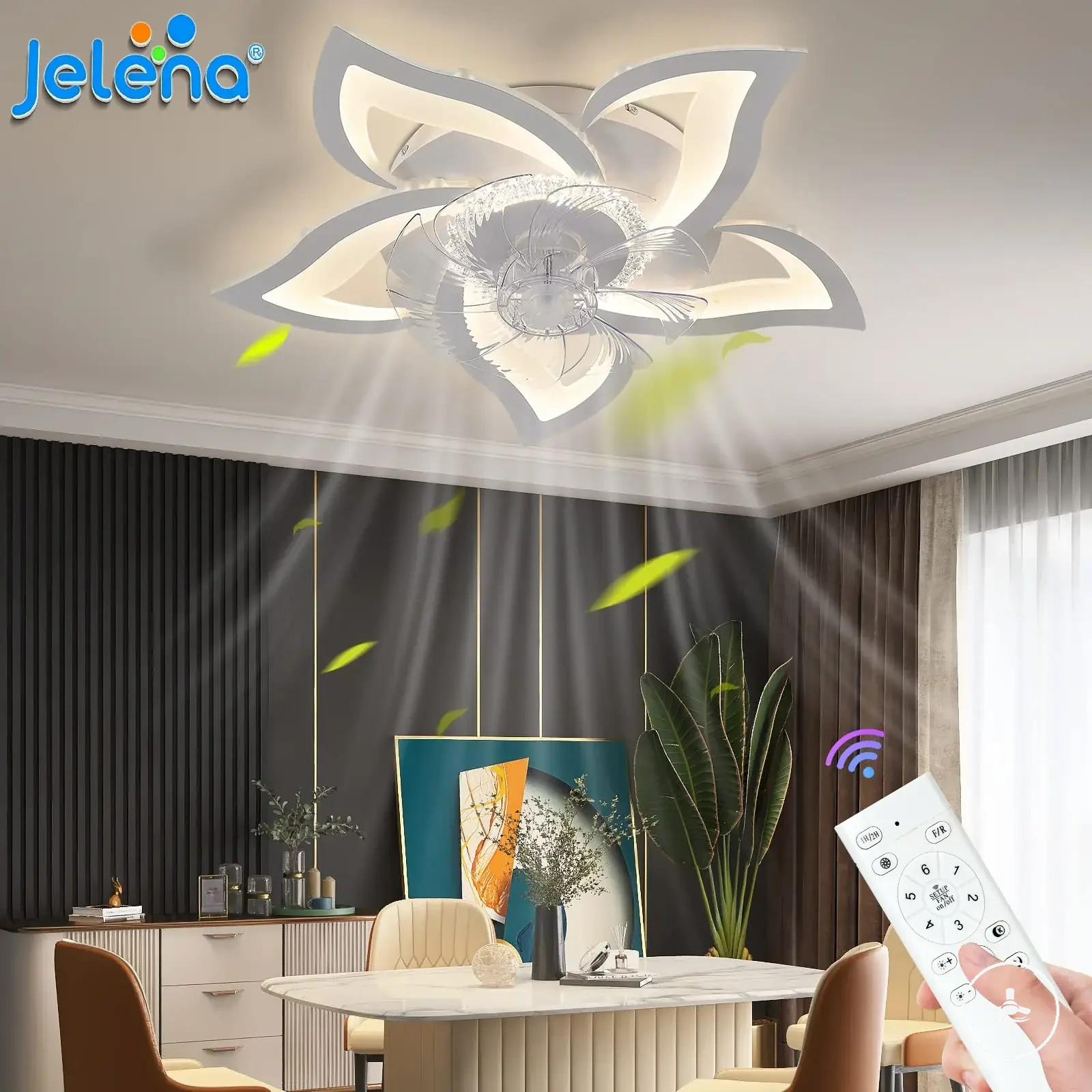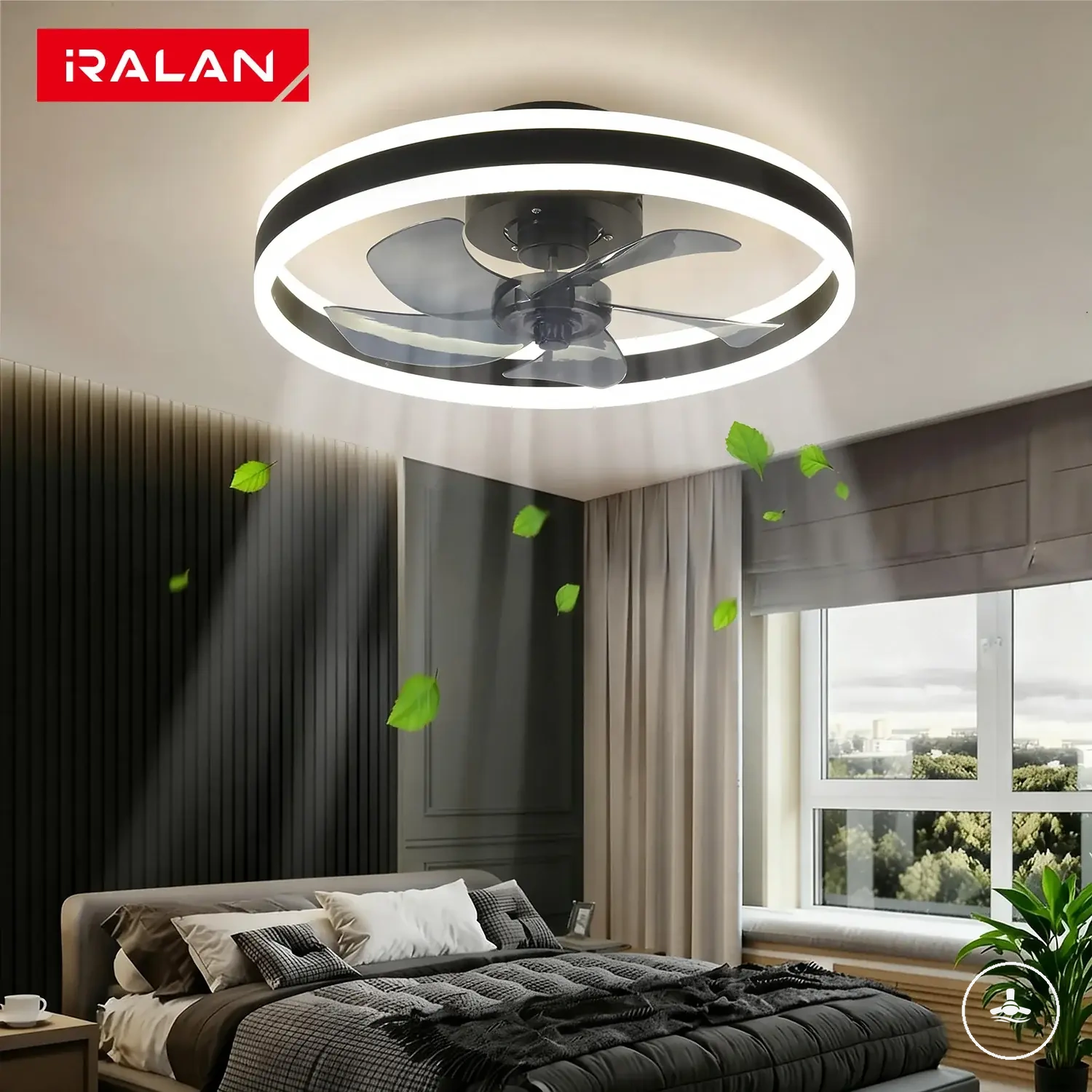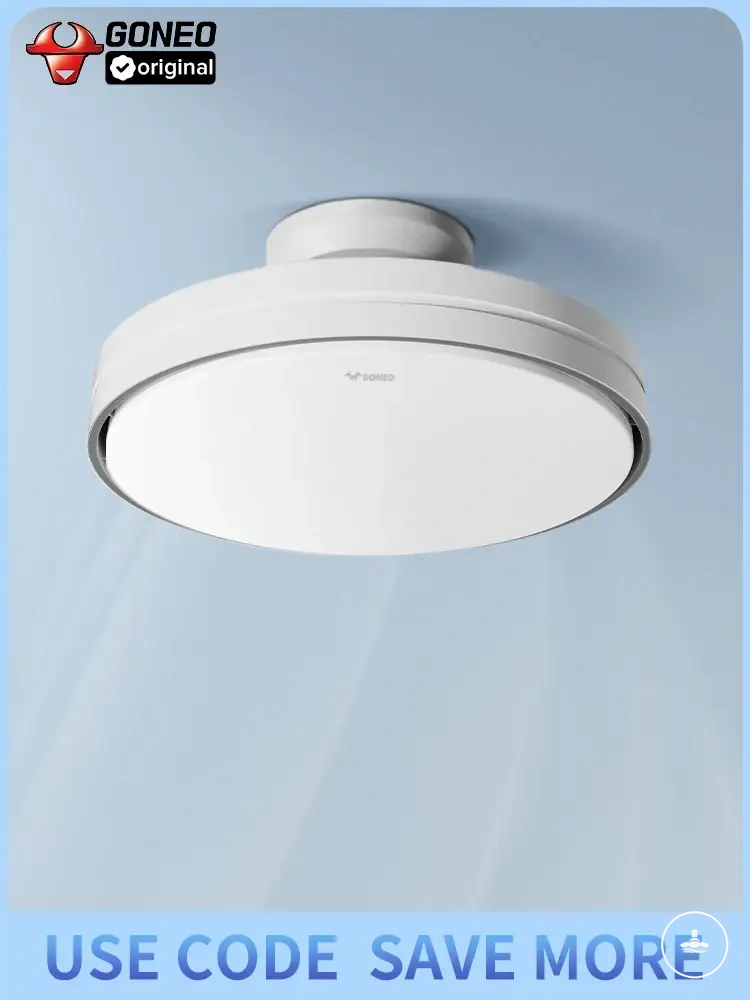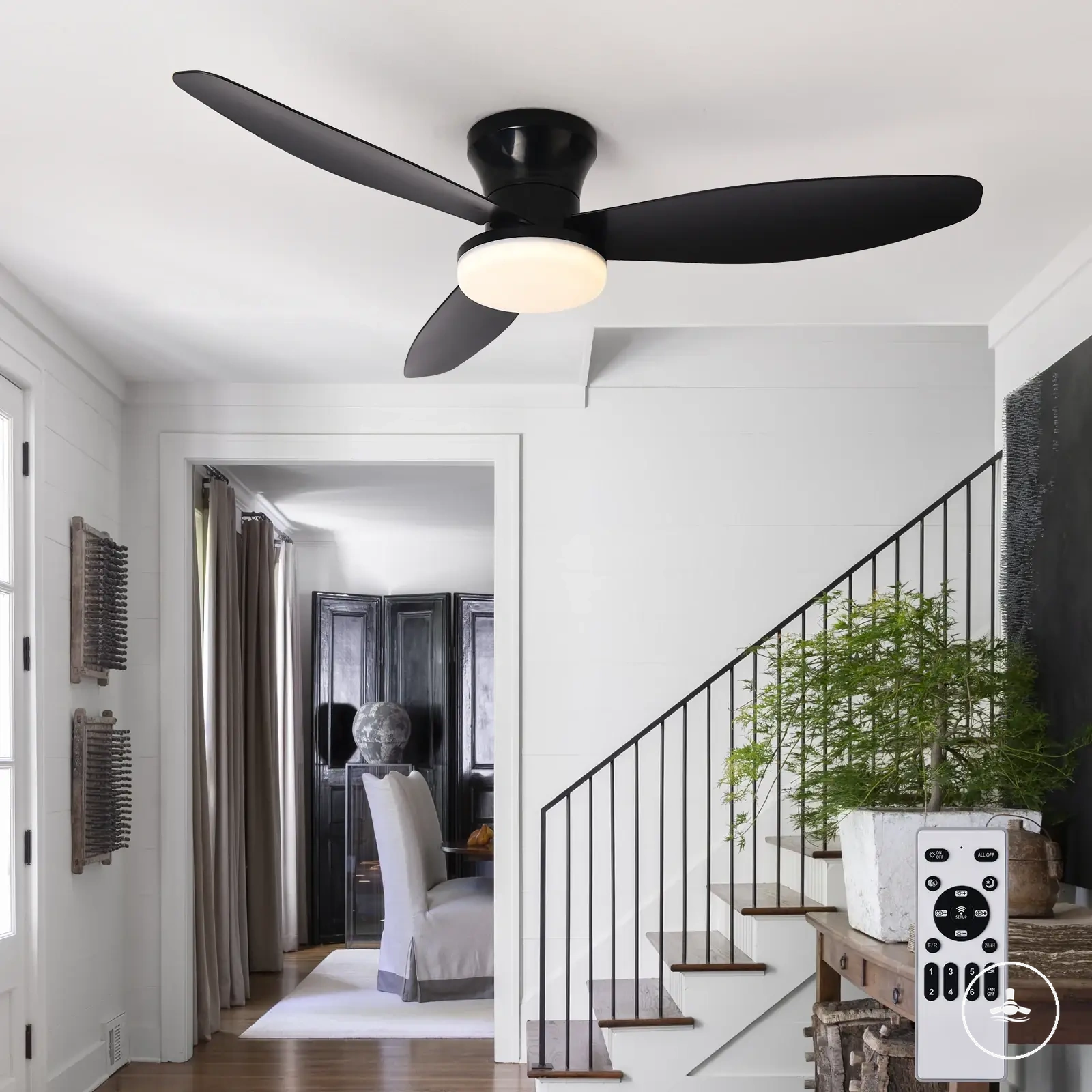
Ceiling Fans with Lights for Bedrooms
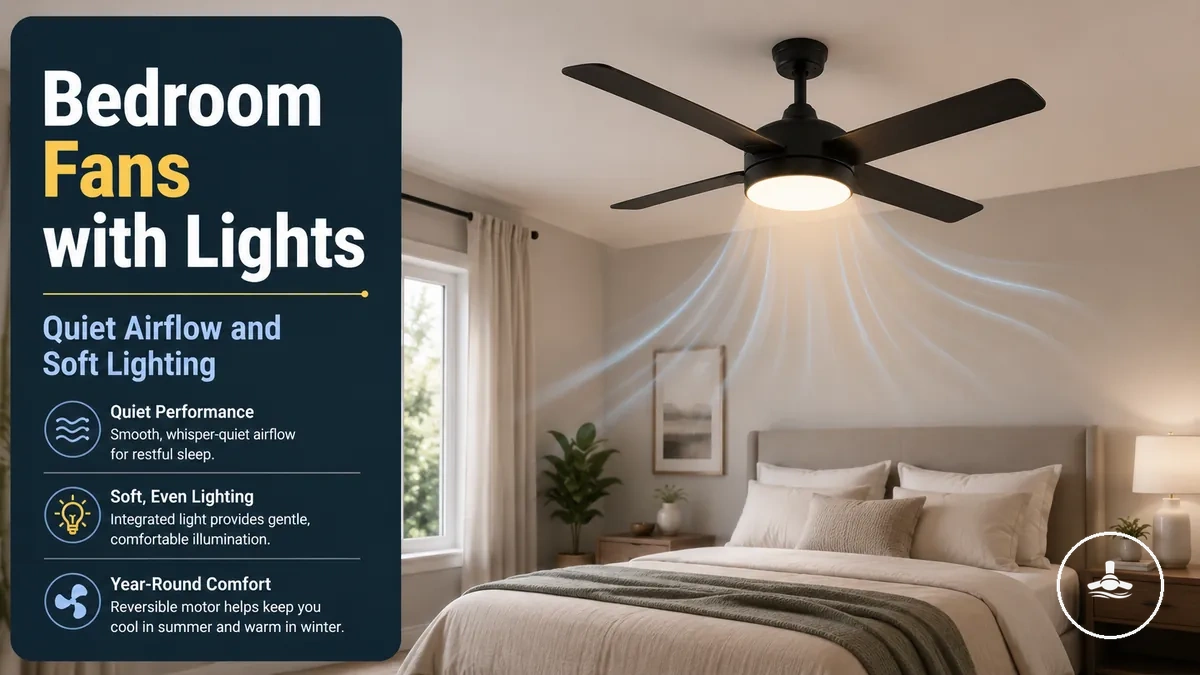
Ceiling fans with lights for bedrooms are most suitable when the room needs comfortable air movement and lighting that can be adjusted to everyday bedroom activities. A bedroom ceiling fan with light can support sleep comfort when quiet airflow, soft lighting, and practical controls are matched to the room's layout and the occupants' preferences. The key selection priorities are quiet airflow and soft lighting, followed by room fit, clearance, and control convenience.
A bedroom may be used for sleeping, reading, winding down in the evening, or sharing with another person, so lighting and airflow needs can change throughout the day. Low fan speed, dimming, and warm light may help create a calmer environment when those features suit the room and user preference. A remote control can also make changing fan speed or light level more convenient without leaving the bed. For a broader overview beyond bedroom-specific considerations, visit the ceiling fans with lights hub.
Choosing the right ceiling fan with light involves balancing comfort with practical fit. Blade span, ceiling height, clearance, bed placement, and control options all influence whether a fan feels appropriate for the space. A low-profile fan or compact fan may suit rooms with limited ceiling height, while larger bedrooms may benefit from different airflow characteristics depending on their layout. These selection criteria provide the foundation for evaluating features in the sections that follow.
Bedroom Comfort Needs for Ceiling Fans with Lights
A bedroom used for sleeping, reading, or relaxing in the evening is usually more comfortable when a ceiling fan with light is selected for everyday bedroom use rather than maximum airflow. Bedroom comfort depends on sleep needs, airflow feel, soft light, noise tolerance, and control access working together. A ceiling fan with light that matches these conditions may create a calmer night-time environment, while greater airflow alone does not necessarily improve comfort.
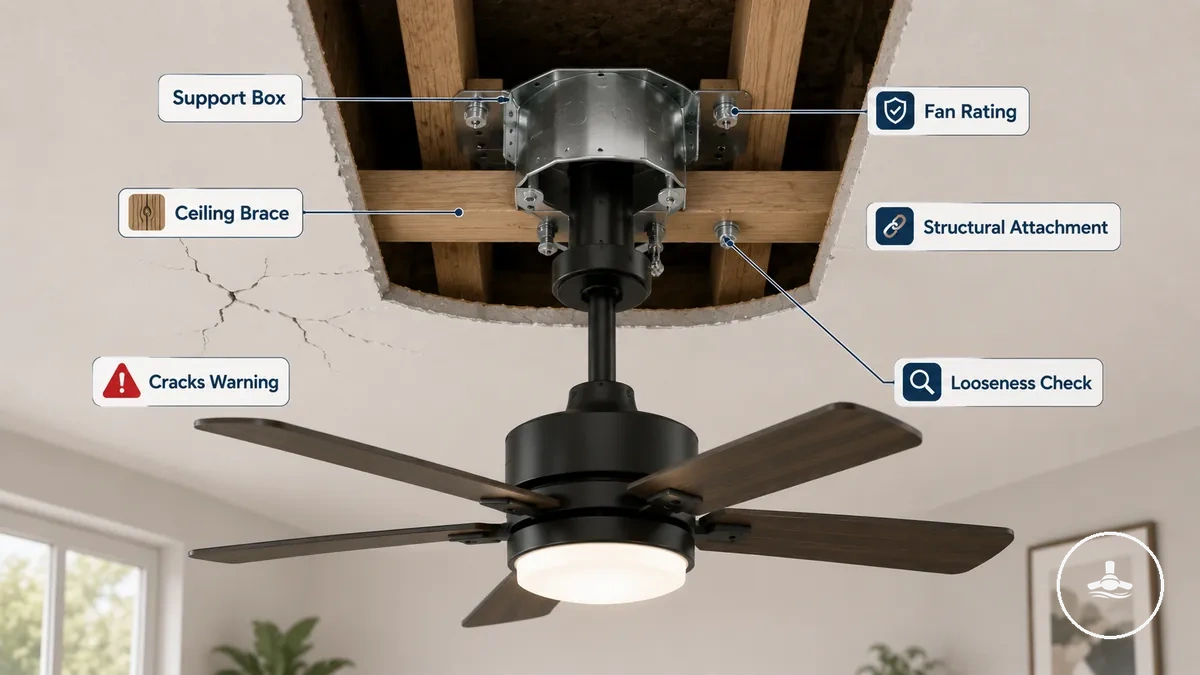
Sleep may be affected when lighting creates glare, controls are difficult to reach, or the airflow feels stronger than preferred. In a shared room, different comfort preferences can make easy adjustments more important during night-time use. Features such as gentle airflow, low-glare lighting, dimming, and convenient control access may help the room adapt to changing needs, although the overall experience still depends on the room layout and individual sensitivity.
Bedroom comfort with a ceiling fan with light is mainly about supporting everyday use without making the room feel overly bright or overly breezy. When the fan is also the main light source, balancing light softness with practical visibility can become more important than increasing brightness. The checklist below groups the main comfort conditions before moving into detailed feature comparisons.
Bedroom Comfort Needs for Ceiling Fans with Lights can be organised around the room situations below.
- Sleep: Match airflow feel to personal noise tolerance and night-time use instead of choosing maximum fan speed.
- Soft light: Low-glare lighting and dimming may create a more comfortable atmosphere for evening reading or relaxation.
- Shared room: Convenient control access, such as bedside or remote control operation, can make adjustments easier for different users.
- Small room or low ceiling: Appropriate clearance and overall fit may improve day-to-day bedroom comfort.
- Main light source: If the ceiling fan with light provides most of the room lighting, balancing brightness with visual comfort is often more useful than focusing on light output alone.
Quiet Airflow for Sleep and Overnight Use
Quiet airflow for sleep and overnight use usually means gentle, stable, low-speed air movement rather than maximum output. In a bedroom, airflow feel is often more important than stronger cooling because steady, low-speed airflow may feel more comfortable throughout the night. Motor smoothness, blade stability, and fan placement can also influence how the airflow is experienced during sleep. The most suitable result depends on the room layout and individual comfort preferences.
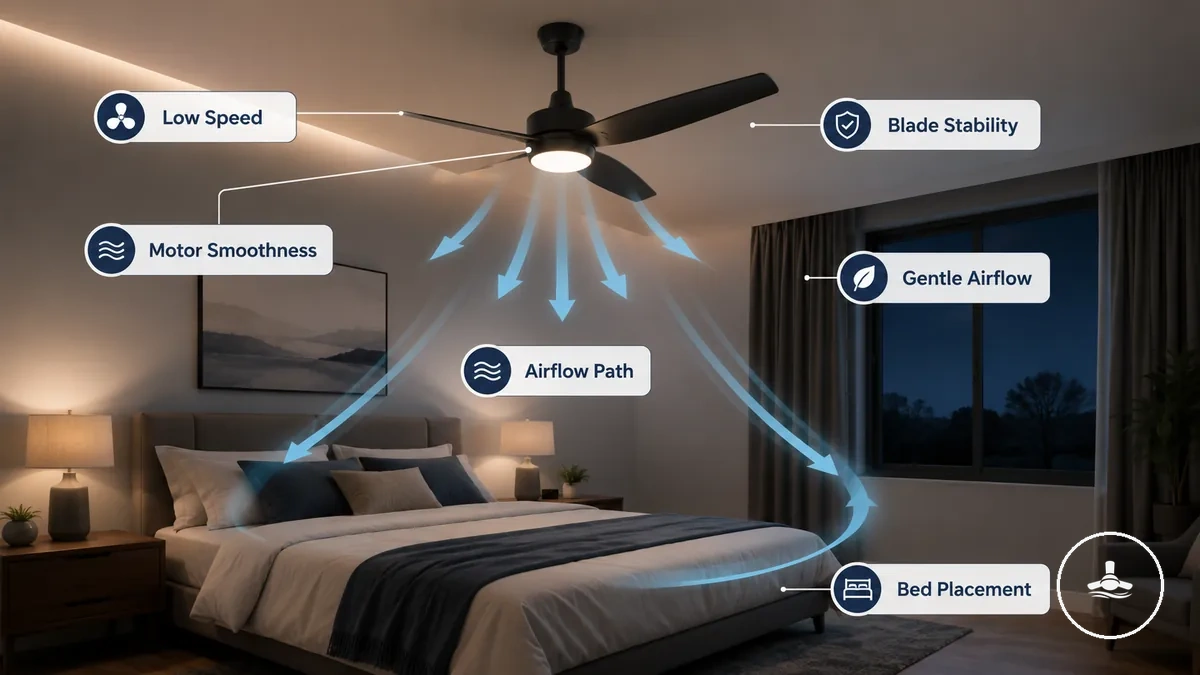
A ceiling fan with light that offers a broad low-speed range can make overnight adjustments easier without relying on higher fan speed. Motor smoothness and blade stability may help reduce perceived vibration or hum, while suitable placement can guide gentle airflow toward the bed without making the airflow feel excessive. Reversible direction can also support seasonal use when different airflow patterns are preferred.
During sleep, gentle airflow is usually more appropriate than the stronger air movement often preferred for daytime cooling. This distinction helps separate overnight usability from maximum airflow, allowing fan speed to match bedroom use instead of aiming for the highest output.
Quiet Airflow for Sleep and Overnight Use can be compared more easily by reviewing the factors below. For broader guidance beyond bedroom-specific conditions, see quiet airflow and fan speeds.
| Airflow factor | Bedroom condition | What to check | Comfort effect |
|---|---|---|---|
| Speed range | Overnight use | Low-speed adjustment | Supports gentler airflow feel |
| Motor smoothness | Sleep environment | Smooth operation | May reduce perceived disturbance |
| Blade stability | Continuous use | Balanced blade movement | Helps maintain steady airflow |
| Reversible airflow | Seasonal use | Direction setting | Allows flexible airflow direction |
| Placement | Bed position | Airflow path | May improve overnight comfort |
Motor Noise, Blade Balance, and Low-Speed Comfort
Perceived fan noise is usually a combination of motor noise, blade movement, and airflow sound rather than a single source. A ceiling fan with light may feel quieter when motor smoothness, blade balance, and low-speed comfort work together instead of relying on marketing claims about silent operation. Room acoustics, speed setting, and mounting condition can also influence perceived noise during sleep, so the experience may vary between bedrooms.
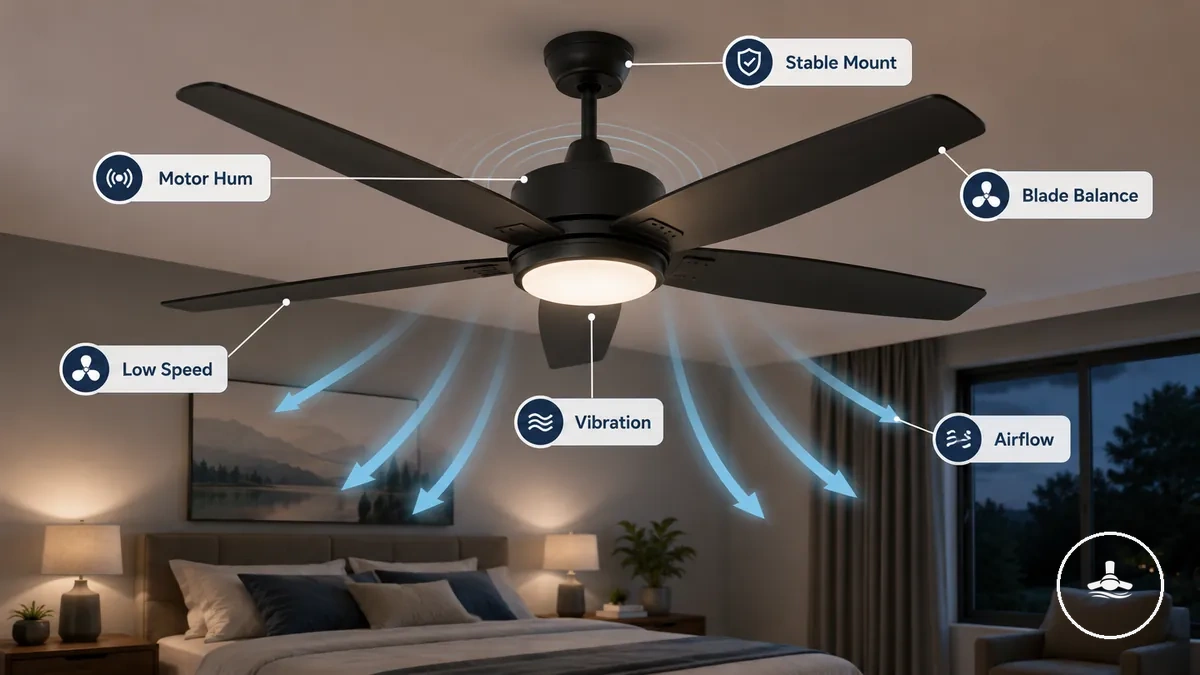
Motor hum may become more noticeable at particular speed settings, while blade wobble or vibration can affect how smoothly the fan operates. Stable mounting and consistent blade alignment may help reduce perceived disturbance, although the result depends on the fan model, room conditions, and low-speed setting. Low-speed comfort is therefore shaped by the combined effect of motor noise, blade balance, and airflow rather than by a single component.
Motor Noise, Blade Balance, and Low-Speed Comfort can be separated into the following local noise sources.
- Motor hum: A steady hum may be easier to notice in a quiet bedroom, which can influence perceived comfort during sleep.
- Blade wobble: Small changes in blade balance may create vibration that contributes to perceived noise.
- Air movement: Gentle airflow usually produces a different sound from stronger airflow, which may affect overnight comfort.
- Speed setting: A low-speed setting may provide smoother airflow when vibration and blade movement remain stable.
Soft Bedroom Lighting, Brightness, and Dimming
Soft bedroom lighting is most effective when a ceiling fan light provides comfortable ambient illumination with controllable brightness instead of simply producing the highest light output. Bedroom lighting usually depends on brightness, dimming, colour temperature, diffuser design, and how the light is used throughout the day. A ceiling fan light that adapts to different situations may support both relaxation and everyday activities while reducing the likelihood of excessive glare.
Brightness is influenced by lumens, but the most suitable light level still depends on room size, diffuser design, and personal preference. A warm light or adjustable colour temperature may create a more relaxing atmosphere for evening use, while a diffuser can help distribute light more evenly and soften perceived glare. Dimming and memory settings may also make it easier to return to a preferred night-time light level without repeated adjustments.
Ambient bedroom light serves a different purpose from reading light or the brighter illumination used for general room activities. Reading may benefit from greater task visibility, while ambient lighting usually prioritises comfort and a calmer atmosphere. A ceiling fan light with independent lighting control and dimming can adapt more easily to these changing bedroom needs.
Soft Bedroom Lighting, Brightness, and Dimming can be compared by considering how each lighting attribute supports different bedroom conditions. For broader LED-specific considerations beyond bedroom use, see soft LED lighting and dimming.
| Lighting factor | Bedroom use condition | Helpful value or condition | Decision effect |
|---|---|---|---|
| Brightness | Ambient or reading use | Suitable lumens for the room | Supports comfortable visibility |
| Colour temperature | Evening or night-time use | Warm light or adjustable setting | May create a softer atmosphere |
| Dimming | Changing light needs | Wide dimming range | Supports flexible light adjustment |
| Diffuser style | General bedroom lighting | Even light distribution | May reduce noticeable glare |
| Independent control | Separate fan and light operation | Individual light control with memory settings | Supports convenient night-time use |
Lumens, Colour Temperature, and Night-Time Light Levels
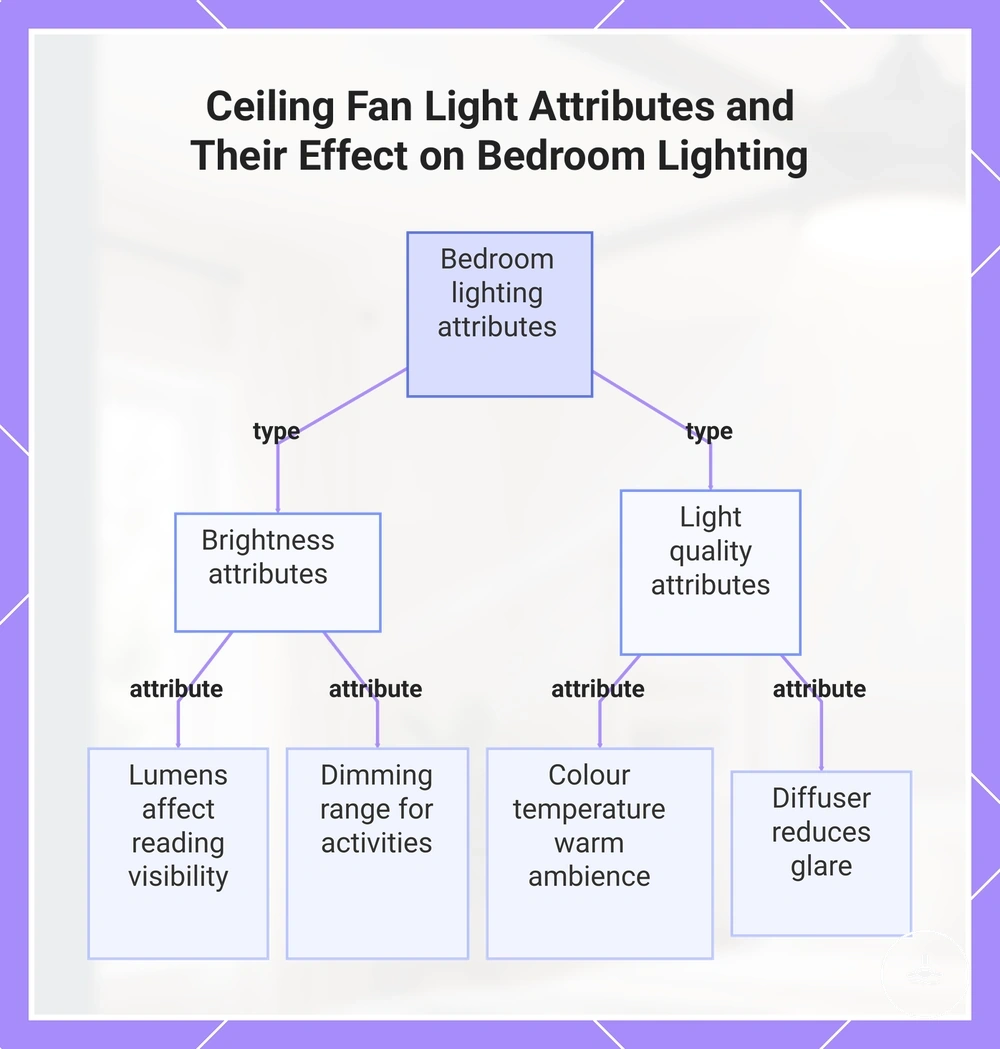
Lumens describe the brightness of a ceiling fan light, while colour temperature describes the appearance of the light. Together, these component attributes influence night-time light, reading visibility, and the overall bedroom atmosphere. The most suitable combination usually depends on room size, fixture design, and whether the ceiling fan light is the primary light source.
A dimming range allows brightness to be adjusted for different bedroom activities, while a diffuser can soften light distribution and help reduce perceived glare. Warm light may create a calmer evening ambience, whereas higher brightness may be more suitable when additional reading visibility is needed. The values below show how each lighting attribute can affect bedroom use.
- Lumens: Describe overall brightness and may influence reading visibility depending on the room.
- Colour temperature: Warm light can support a more relaxing night-time ambience.
- Dimming range: Adjustable brightness may help match changing evening and night-time lighting needs.
- Diffuser: Soft diffusion can reduce perceived glare and create more even light distribution.
This chart shows the main lighting attributes of a ceiling fan light and how they influence brightness, ambience, and visibility in a bedroom.
Bedroom Size, Ceiling Height, and Fan Fit
Bedroom size, ceiling height, blade span, and clearance should be evaluated together when choosing a ceiling fan with light. Fan fit depends on how these conditions work together rather than on a single feature or fan size. A suitable fit may improve room coverage, maintain balanced visual proportion, and help preserve comfortable clearance throughout the bedroom.
Blade span influences airflow reach across the room, while mounting depth affects how far the fan extends below the ceiling. A compact fan may suit a smaller bedroom when room coverage remains appropriate, while a low-profile fan can be more suitable where ceiling height limits available clearance. The preferred fan fit still depends on bedroom size, ceiling height, mounting type, and how the fan relates to the room's proportions.
Bed placement, wardrobes, doors, and other furniture can reduce usable clearance even when the room appears large enough. Reviewing these obstacles before selecting a fan may help maintain comfortable movement, suitable airflow, and balanced visual proportion. The final fan fit should therefore be assessed according to the complete bedroom layout rather than room size alone.
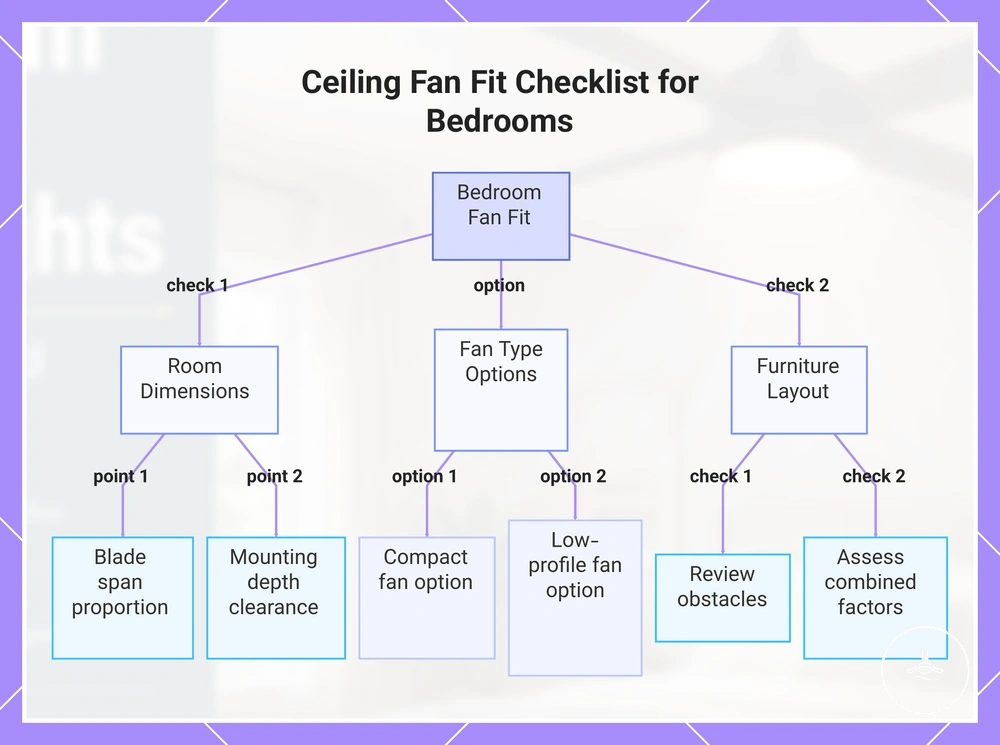
Bedroom Size, Ceiling Height, and Fan Fit can be verified with the checklist below to review both room dimensions and clearance conditions. For broader guidance beyond bedroom-specific fit decisions, see bedroom size and blade span.
- Bedroom size: Check whether the blade span is proportionate to the room so airflow reach and room coverage remain balanced.
- Ceiling height: Confirm that mounting depth provides suitable clearance for the available ceiling height.
- Compact fan: Consider a compact fan for a smaller bedroom while confirming that room coverage remains appropriate.
- Low-profile fan: A low-profile fan may improve fan fit where ceiling height limits clearance.
- Furniture layout: Review bed placement, wardrobes, and doors to maintain usable clearance around the fan.
- Fit check: Assess room size, ceiling height, mounting type, and furniture together before making a final selection.
This chart shows the main checks and options for selecting a ceiling fan that fits a bedroom's size, ceiling height, and furniture layout.
Small Bedrooms and Compact Fan Span
A compact fan span can suit a small bedroom when airflow reach, light coverage, and blade clearance remain appropriate for the room. Compact fan span changes how air and light are distributed, so housing size and room proportion should be considered together. A smaller span may improve visual fit, provided it still delivers usable airflow without overpowering the space.
Compact fan span also affects how the fan appears within the room and how evenly airflow and light are distributed. A compact fan may create a more balanced visual fit where furniture limits available space, while a shorter blade span may reduce airflow reach if broader room coverage is needed. The most suitable choice depends on balancing compact proportions with adequate airflow, light coverage, and housing size for the bedroom.
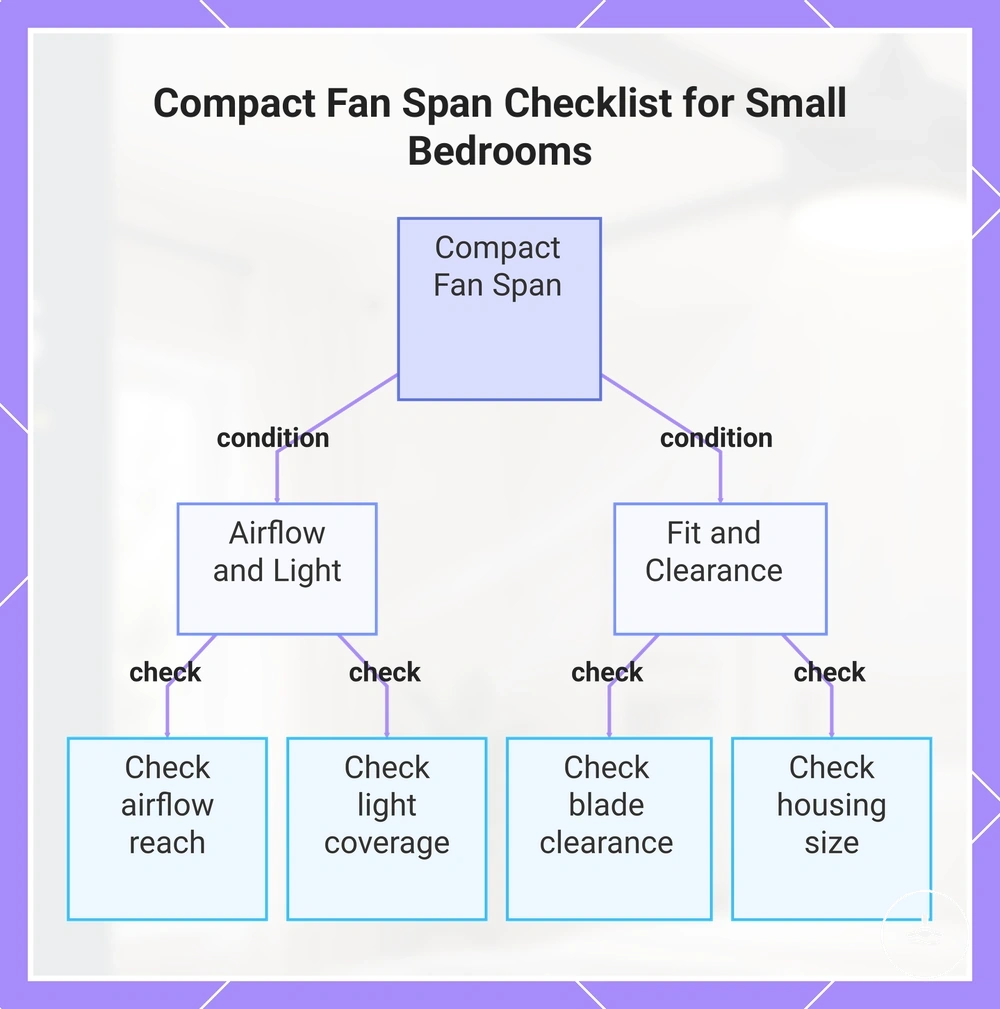
The checklist below helps compare compact fan span with local bedroom conditions.
- Compact fan span: Check that airflow reach remains suitable for the small bedroom.
- Blade clearance: Confirm that nearby furniture allows comfortable blade clearance.
- Housing size: Compare the fan housing size with the room so visual fit remains proportionate.
- Light coverage: Consider whether the ceiling fan light provides suitable coverage without overpowering the room.
This chart shows the key conditions to check when selecting a compact fan span for a small bedroom, including airflow, light, clearance, and housing size.
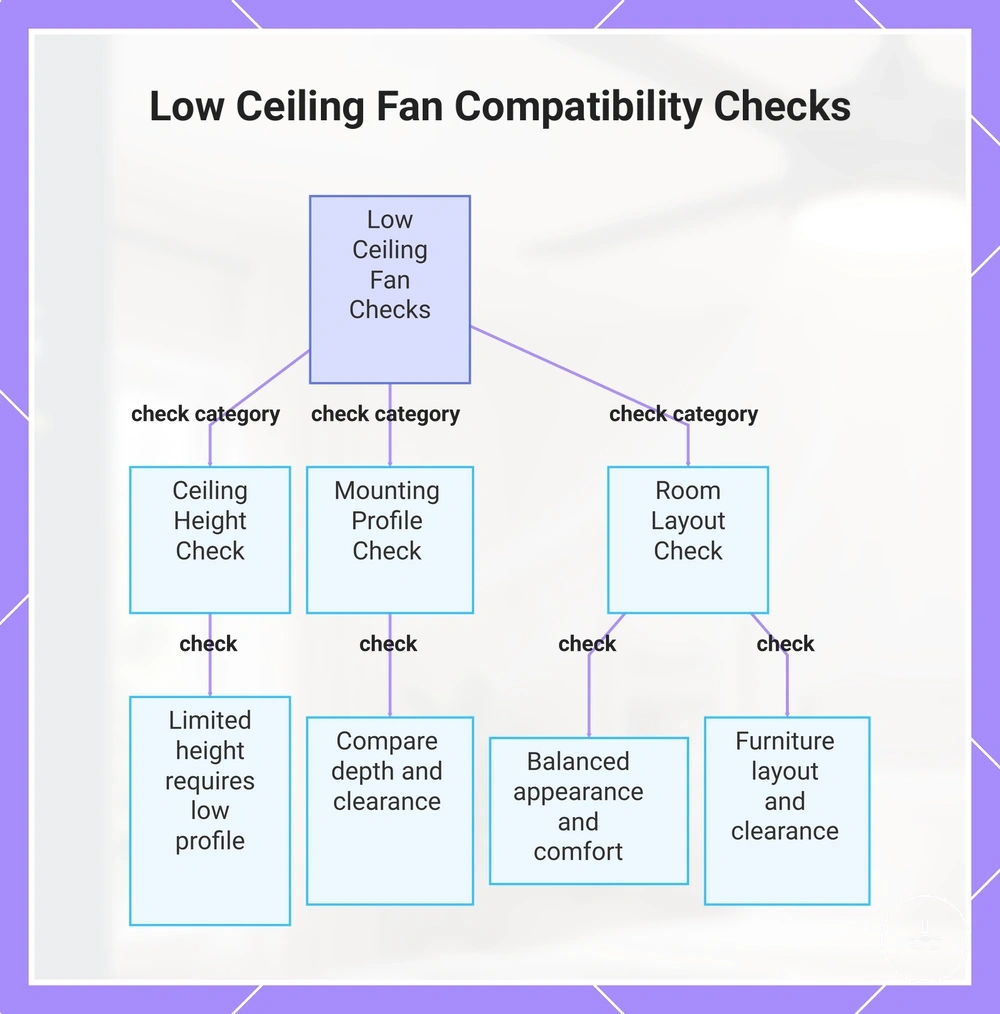
Low Ceilings and Flush Mount Bedroom Fans
Low ceilings may make a flush mount or low-profile fan a more suitable bedroom fit when ceiling height and clearance limit a standard mount. A flush mount, hugger fan, or low-profile fan reduces mounting depth, which may help provide more headroom in a bedroom with limited ceiling height. The most suitable option still depends on available clearance, bedroom fit, and the overall room layout.
Mounting depth affects how far a ceiling fan extends below the ceiling, while clearance influences comfortable movement beneath it. Compared with a standard mount, a flush mount or low-profile fan may reduce visual heaviness in a small room and better suit bed placement where ceiling height is limited. The preferred mounting profile should still be chosen according to the complete bedroom layout rather than ceiling height alone.
Low Ceilings and Flush Mount Bedroom Fans can be checked using the conditions below to compare local compatibility. More detailed low-ceiling constraints belong outside this bedroom fit discussion; for broader guidance, see low profile bedroom fit.
- Low ceiling: Consider whether limited ceiling height makes a lower mounting profile more appropriate.
- Flush mount or hugger fan: Compare mounting depth with the available clearance and headroom.
- Bedroom fit: Check whether a low-profile fan provides a balanced appearance while maintaining usable comfort.
- Bed placement: Review furniture layout and movement areas when assessing clearance around the fan.
This chart shows the three main categories of checks for selecting a flush mount fan in a bedroom with low ceilings.
Bed Placement, Blade Clearance, and Safety
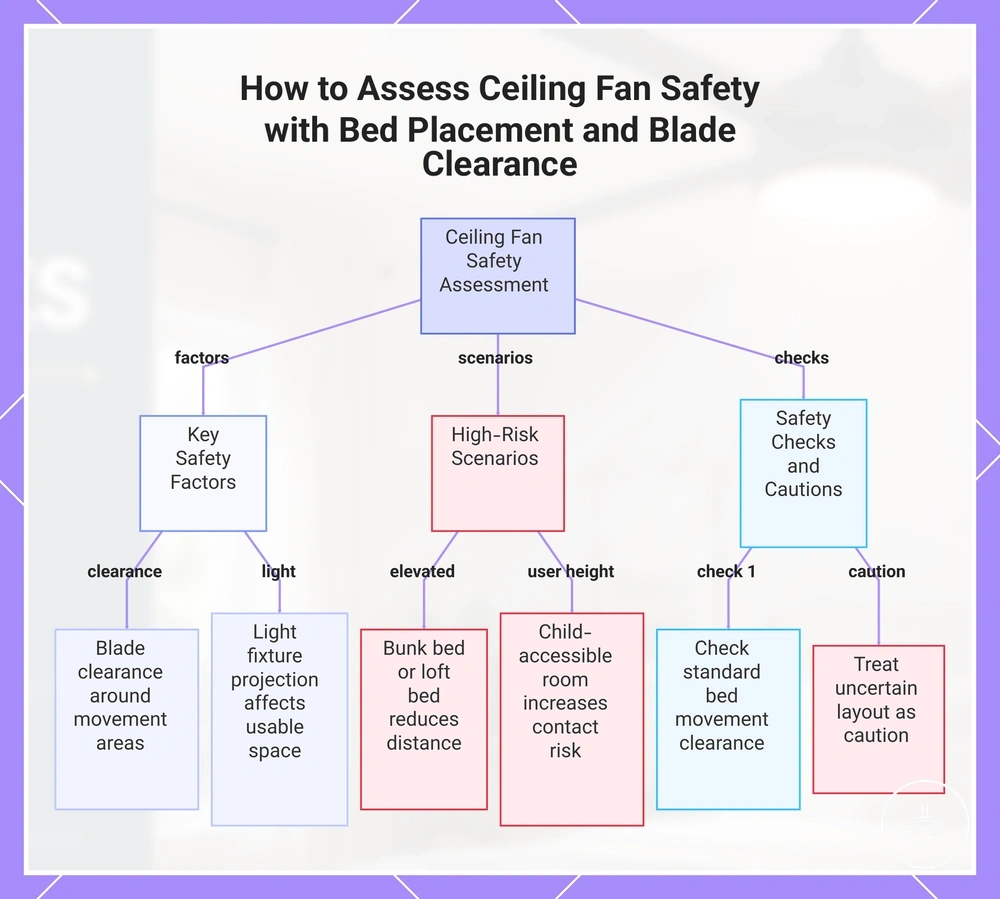
Safe bed placement depends on blade clearance, mounting stability, blade position, and who uses the room. A ceiling fan with light may provide suitable bedroom use when bed placement, user height, and available clearance are considered together. Contact risk can change with room layout, so safety should be assessed according to the specific bedroom rather than assumed from the fan alone.
Bed placement influences how close occupants are to the blade sweep and light fixture during everyday use. Blade clearance should be considered around the sleeping area as well as places where people stand or move, while the light fixture projection may also affect the usable space beneath the fan. Mounting stability is an important safety attribute, but the overall room context remains part of the clearance check rather than an installation decision.
Bunk bed and loft bed layouts may require additional caution because elevated sleeping positions can reduce the distance between the user and the ceiling fan with light. In child-accessible rooms, user height and the possibility of standing or climbing near the fan may increase contact risk when clearance is limited. If bed placement or blade clearance remains uncertain, treat the layout as a caution condition before relying on the existing arrangement.
Bed Placement, Blade Clearance, and Safety can be reviewed with the checklist below to verify placement conditions and possible clearance risks.
- Standard bed: Check that blade clearance supports comfortable movement around the sleeping area.
- Bunk bed: Elevated sleeping positions may increase contact risk because the blade sweep is closer to the user.
- Loft bed: Compare user height with the available blade clearance before deciding whether the layout appears suitable.
- Child-accessible room: Use additional caution where children may stand or climb near the ceiling fan with light.
- Light fixture projection: Consider whether the light fixture and fan together affect comfortable movement beneath the ceiling fan.
- Mounting stability: If the mounting condition appears uncertain, avoid assuming the current placement provides suitable safety.
This chart shows the key safety factors, high-risk scenarios, and recommended checks for placing a bed near a ceiling fan with light.
Ceiling Fans Above Beds, Bunk Beds, and Loft Beds
Ceiling fan placement above a bed may be suitable when clearance, mounting, fan size, and user access fit the room conditions. Above-bed placement should be assessed according to the available clearance rather than bed location alone. User access and everyday movement also influence whether safe placement is appropriate for the sleeping area.
A standard bed usually presents a different reach risk from a bunk bed or loft bed because elevated beds place occupants closer to the fan. Bunk bed and loft bed layouts may require additional caution when user access changes the available clearance around the fan. If reach risk remains high because of bed type or room layout, an alternative layout may be a more suitable option.
Ceiling Fans Above Beds, Bunk Beds, and Loft Beds can be reviewed using the conditions below to separate common reach-risk situations.
- Above bed: Consider safe placement only when clearance and fan size suit the sleeping area.
- Standard bed: Normal bed height may present lower reach risk than an elevated bed when user access is limited.
- Bunk bed: Elevated sleeping positions may increase reach risk because occupants are closer to the fan.
- Loft bed: Review clearance and user access carefully before deciding whether the layout appears appropriate.
- Child-accessible room: Where children may climb or reach toward the fan, an alternative layout may deserve additional consideration.
Bedroom Controls for Fan Speed, Light Level, and Remote Use
Bedroom controls should make fan speed and light level adjustments easy without disrupting sleep. The most suitable control setup depends on how the room is used, whether changes are made from the bedside, and which control functions are supported by the ceiling fan with light. A setup that allows simple night-time adjustments may improve convenience while reducing the need to move around in low light.
Remote use can make bedside control more convenient when fan speed or light level needs to change during the night. Wall control may suit bedrooms where a fixed control location is preferred, while dimming can help adapt the light level for evening or overnight use when supported. A timer may suit users who prefer the fan or light to change after a period of use, and a memory setting may return to a previously selected configuration. Independent fan-light operation can also make it easier to adjust airflow without changing the light, or the light without changing the fan.
Control compatibility depends on the fan design and control setup rather than the control type alone. In a shared room, remote use, bedside control, or independent fan-light operation may reduce disturbance when one person wants to adjust comfort without affecting the other. Choosing bedroom controls is therefore best based on night-time habits, convenience, and the available control options.
Bedroom Controls for Fan Speed, Light Level, and Remote Use can be compared using the guide below to help match each control function with common bedroom conditions.
| Control type | Potential benefit | Possible limitation | Best bedroom use |
|---|---|---|---|
| Remote control | Convenient bedside adjustment | Compatibility depends on the fan and control setup | Night-time fan speed or light level changes |
| Wall control | Fixed and familiar operation | Requires leaving the bedside to make changes | Frequent daytime use |
| Dimming and memory setting | Supports preferred light levels for different routines | Availability depends on the lighting system | Evening relaxation and overnight lighting |
| Timer and independent fan-light operation | Allows airflow and lighting to be managed separately | Functions may vary by control setup | Shared rooms and changing sleep preferences |
Choosing a Bedroom Ceiling Fan with Light by Comfort Priority
The right bedroom ceiling fan with light depends on the strongest comfort priority in the room. A bedroom focused on sleep may need quiet airflow first, while a room used for reading may place more weight on soft lighting and dimming. The shortlist decision should follow the constraint that affects daily comfort most, then check fit, control, and safety conditions before comparing options.
Comfort priority can be grouped into quiet airflow, soft lighting, fit, control, and safety. Quiet airflow points toward stable low-speed performance, while soft lighting points toward dimming, glare control, and warm light. Small-room fit and low-ceiling fit depend on blade span, clearance, and mounting depth, while remote control supports easier fan speed and light level changes during night use.
Each priority creates a trade-off. A compact fan may support small-room fit but still needs enough airflow reach and light spread. A low-profile option may improve clearance, but the bedroom still needs suitable room coverage and visual proportion. Remote control may improve convenience, although compatibility depends on the fan and control setup.
Choosing a Bedroom Ceiling Fan with Light by Comfort Priority is easier when each room need is matched to one main feature and one trade-off. After the criteria are clear, broader comparisons can continue through best options by room need.
| Comfort priority | Feature to prioritize | Trade-off to check | Selection direction |
|---|---|---|---|
| Quiet airflow | Low-speed airflow and stable operation | Check perceived noise and airflow feel | Shortlist fans suited to sleep-focused use |
| Soft lighting | Dimming and glare control | Check reading needs and night-time light level | Choose a ceiling fan light that supports bedroom comfort |
| Small-room fit | Compact proportions and blade span | Check airflow reach and light coverage | Prefer a balanced fit rather than the smallest option alone |
| Low-ceiling fit | Low-profile fan or flush mount | Check clearance and mounting depth | Shortlist options that preserve usable headroom |
| Remote control | Bedside control and independent fan-light operation | Check compatibility and supported control functions | Prioritize easier night-use adjustment |
| Safety | Bed placement and blade clearance | Check user height, elevated beds, and contact risk | Use caution when clearance or access is uncertain |
Use the table as a shortlist filter rather than a product ranking. When two priorities compete, choose the option that resolves the stronger bedroom constraint first, then confirm that the remaining airflow, lighting, fit, control, and safety conditions are still acceptable for the room.
Here are product examples that may make comparison easier. Before buying, always review the compatibility criteria, essential features, and product details.