
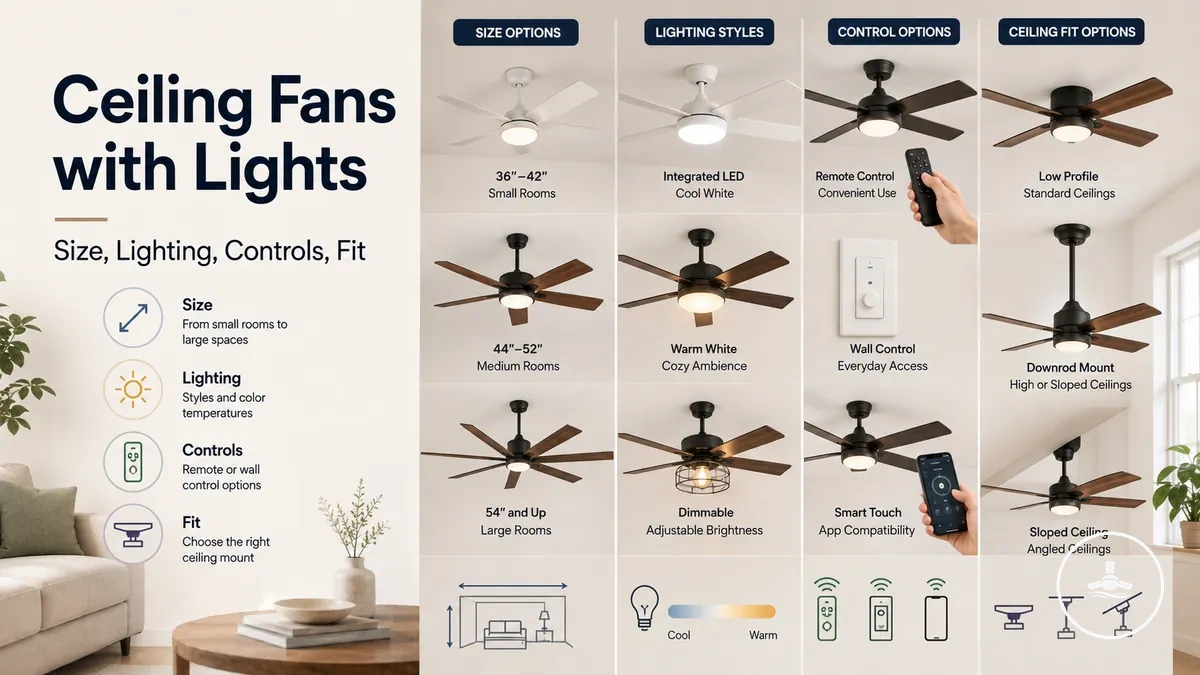
Ceiling fans with lights as a category combining airflow, lighting, controls, and room fit considerations
Ceiling fans with lights represent a combined category where airflow performance and integrated lighting work together within a single ceiling-mounted system. The category is defined by how the fan motor generates airflow while an integrated LED lighting system or light kit provides room illumination. These two functions operate through a shared housing structure, which also connects to control systems that manage speed, dimming, and switching behavior. The overall performance depends on how effectively motor output translates into airflow performance and how LED lighting translates into usable brightness and ambient balance. Ceiling fit also becomes a structural factor, as mounting design and clearance conditions influence safe and effective operation. This category is therefore organized around four decision dimensions: airflow output, lighting behavior, control systems, and ceiling and room compatibility.
Ceiling fans with lights function as integrated systems where airflow performance is shaped by motor efficiency and blade design, while LED lighting determines brightness consistency and dimming behavior. Controls such as remote, wall-mounted, or smart systems act as the interaction layer that coordinates both airflow and lighting functions in daily use. Ceiling fit influences how well the unit aligns with ceiling height, slope conditions, and structural clearance requirements, which can affect both comfort and safety conditions. Room coverage becomes a practical outcome of how airflow distribution and lighting spread across the space, especially in relation to room dimensions. These factors work together without one function fully dominating the other, so evaluation depends on balancing airflow, lighting, control usability, and ceiling compatibility within the same system boundary.
In bedroom environments, ceiling fans with lights are often interpreted through quieter airflow patterns and softer lighting behavior that supports low-distraction conditions. In living rooms, the same category is evaluated more through wider room coverage and stronger airflow distribution combined with brighter lighting needs. Low-ceiling spaces place more emphasis on compact mounting and ceiling fit constraints, while larger or open rooms prioritize airflow reach and lighting spread across wider areas. Each scenario changes how the same core system is assessed, even though the underlying structure remains consistent across airflow, lighting, controls, and fit. These scenario-based differences lead into more detailed evaluation of each dimension in the following sections.
What ceiling fans with lights are and how they function as combined airflow and lighting solutions
Ceiling fans with lights are a single integrated fixture that combines an airflow system with a built-in lighting system to deliver both air circulation and illumination from the same ceiling unit. The category is defined by the interaction between a fan motor that generates airflow and an LED module or light kit that produces visible room lighting. These components are unified through a shared housing design that supports both mechanical rotation and electrical lighting integration. Control systems connect these functions by managing fan speed, lighting output, and switching behavior through a single interface. In many cases, understanding what ceiling fans with lights mean helps clarify how airflow and lighting are structurally linked within one system rather than operating as separate fixtures.
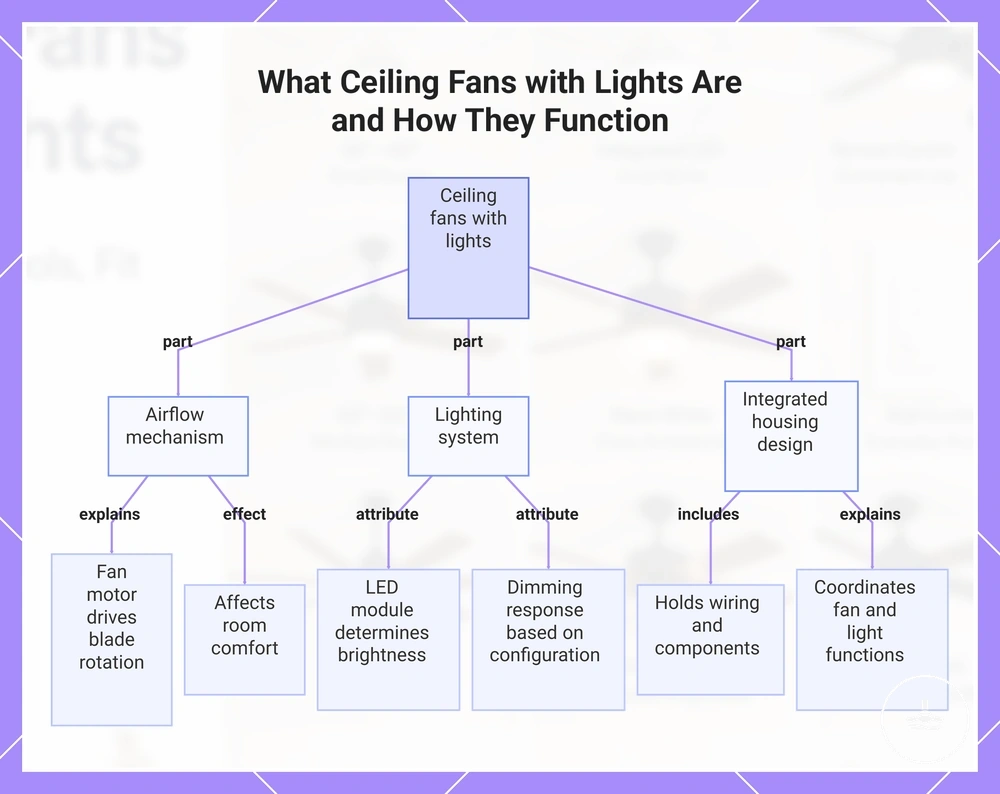
The function of ceiling fans with lights is structured around three core elements: the airflow mechanism, the lighting system, and the integrated housing design. The fan motor drives blade rotation to create airflow performance that influences room comfort, while the LED module determines brightness behavior and dimming response based on its configuration. The housing design supports both systems by holding electrical wiring, mounting components, and control receivers in a unified structure. Control systems act as the coordination layer, allowing airflow adjustments and lighting changes to operate together or independently depending on setup. This integrated design creates a single system where airflow and lighting functions are mechanically and electrically interdependent, forming the basis for how the category operates.
This chart shows the core components and integrated design of ceiling fans with lights, explaining how airflow and lighting functions are combined in a single fixture.
Key benefits and limitations of ceiling fans with lights for different room environments
Ceiling fans with lights perform differently across room environments because their airflow system, LED lighting, and control system interact with variables like room size, ceiling height, and lighting requirements. Their overall effectiveness depends on how well airflow efficiency distributes air in a given space, how LED brightness supports lighting usefulness, and how ceiling height influences circulation patterns. Control usability also affects how consistently both airflow and lighting can be adjusted during daily use. These environmental dependencies create a balanced view of where the system performs well and where constraints may appear. The outcomes can be grouped into benefits and limitations based on room conditions.
Benefits of ceiling fans with lights are most noticeable in rooms where airflow efficiency matches room size and layout, allowing more even air distribution and stable comfort levels. In moderate-sized spaces, the airflow system can support consistent circulation while LED brightness provides sufficient ambient lighting for general use. Ceiling height compatibility also plays a role, as suitable clearance often supports smoother airflow movement and balanced coverage. Control usability enhances convenience by allowing both airflow and lighting adjustments through a single control system. These advantages become more relevant when the room environment aligns with the design range of the fixture.
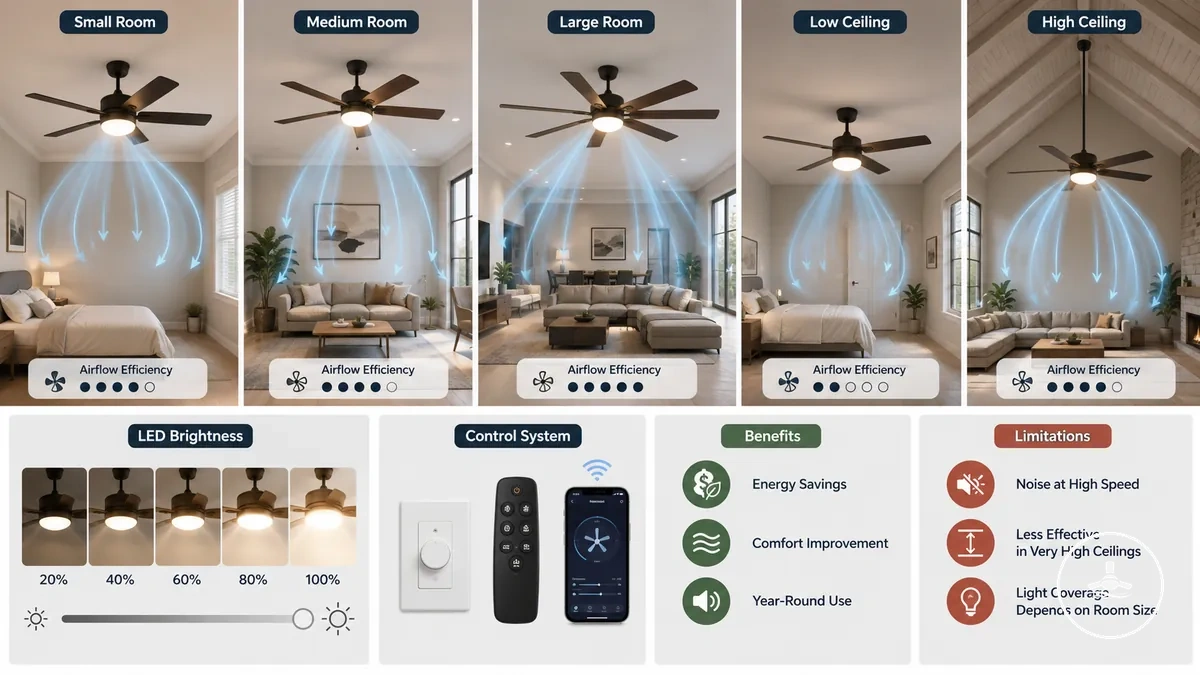
Limitations appear when environmental conditions move beyond the effective range of airflow efficiency or LED lighting usefulness. In larger rooms, airflow distribution may feel less uniform, while in smaller or low-ceiling spaces, circulation patterns can be restricted by reduced clearance. LED brightness may also feel insufficient in environments that require stronger task lighting or layered illumination setups. Control usability may vary depending on installation position and accessibility within the room environment. These limitations depend strongly on how closely the space matches the operational balance of airflow, lighting, and ceiling fit conditions.
How to choose ceiling fans with lights based on room needs, usage goals, and selection criteria
Choosing ceiling fans with lights depends on how room needs, usage goals, and selection criteria interact with airflow performance, lighting requirements, and ceiling compatibility. The decision process is shaped by matching blade span to room size, aligning LED lighting output with ambient or task needs, and ensuring control systems support daily usability preferences. Ceiling height and structural constraints also influence which configurations can operate effectively within a given space. Instead of focusing on a single feature, the selection process evaluates how airflow efficiency, lighting quality, and installation conditions work together. These factors establish a structured approach to selecting the most suitable configuration based on environment-driven criteria. :contentReference[oaicite:0]{index=0}
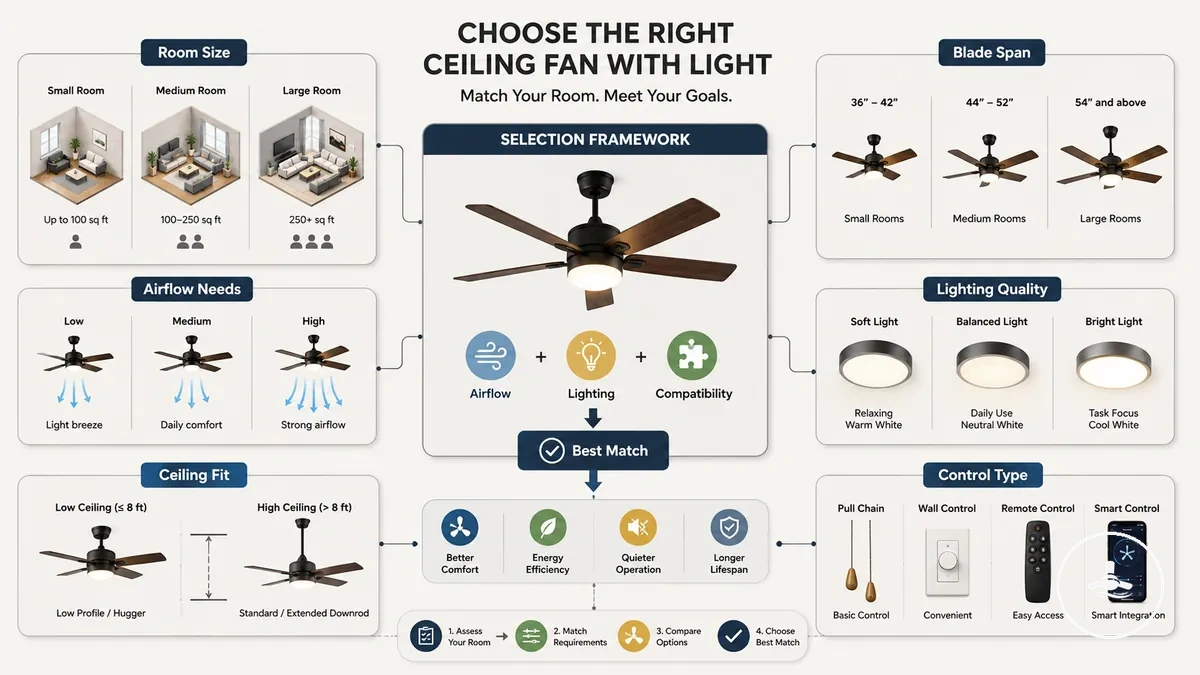
Selection criteria for ceiling fans with lights can be organized into structured decision points that connect room requirements with functional performance. These criteria help evaluate how well a configuration aligns with airflow needs, lighting expectations, and physical installation constraints.
- Blade span vs room size compatibility
- Airflow efficiency vs comfort needs
- LED brightness vs lighting requirements
- Control type vs usability preference
- Ceiling height vs airflow clearance
- Room purpose vs usage intensity
- Installation fit vs structural constraints
The buying checklist for ceiling fans with lights helps consolidate these criteria into a structured evaluation flow that supports consistent decision-making across different room environments. Decision logic typically prioritizes room size and airflow requirements first, followed by lighting suitability and control usability to ensure balanced performance outcomes. Ceiling constraints then determine final compatibility before selection is finalized. This structured approach naturally leads into more detailed considerations around sizing and physical fit requirements in the next stage of evaluation.
Ceiling fan size and room coverage requirements for balanced airflow and comfort
Ceiling fan size is primarily determined by blade span, which directly influences airflow radius and how effectively air is distributed across a room. The relationship between fan dimensions and room geometry shapes overall circulation efficiency, especially when ceiling height affects how airflow intensity is perceived at ground level. Larger spaces typically require wider blade spans to maintain balanced movement, while smaller rooms rely on compact configurations to avoid uneven circulation. Understanding this sizing logic helps align physical fit with comfort needs before selecting any configuration, leading into clear room size segmentation. :contentReference[oaicite:0]{index=0}
Selection based on room size follows a structured approach where blade span determines airflow coverage and how evenly air is distributed within enclosed space boundaries. The concept of ceiling fan size and room coverage connects directly to how geometry and airflow radius interact across different room types. This relationship becomes clearer when comparing small, medium, and large room conditions.
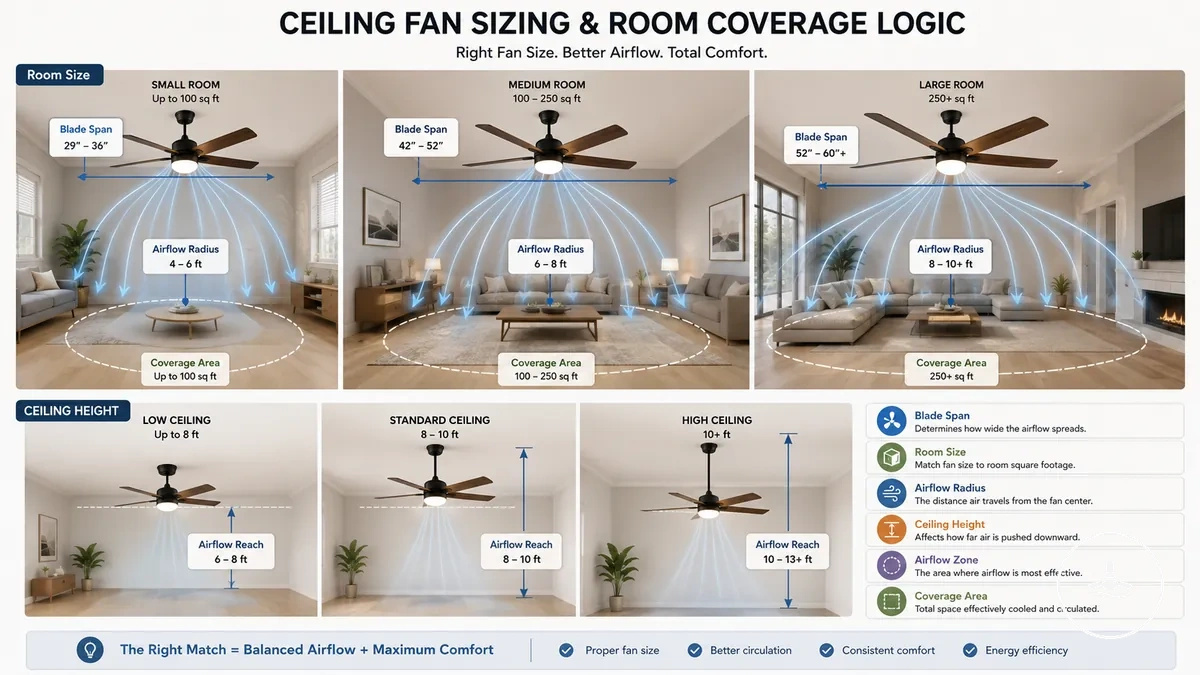
- Small rooms: lower blade span, tighter airflow radius, localized circulation efficiency
- Medium rooms: balanced blade span, moderate airflow radius, even circulation distribution
- Large rooms: wider blade span, extended airflow radius, broader coverage requirements
Small room configurations typically prioritize compact blade span to prevent over-circulation, while medium spaces benefit from balanced airflow distribution that maintains consistent comfort levels across the area. In larger rooms, airflow efficiency depends more heavily on extended blade span to support full room coverage and reduce stagnant zones. Ceiling height also influences perceived airflow strength, as higher ceilings may disperse movement before it reaches occupied zones. These sizing constraints form the basis for transitioning into broader selection and environmental adaptation considerations in the next section.
Lighting performance factors including brightness, colour temperature, LED types, and dimming behaviour
The LED lighting system in ceiling fans defines how light output is generated, adjusted, and experienced in indoor environments. It is structured around LED type, brightness level, colour temperature, and dimming capability, with each attribute shaping a different aspect of lighting consistency and visual comfort. These components determine how stable or adjustable the light output appears during everyday use. The concept of LED lighting options for ceiling fans refers to how these configurations are organized to support different usage needs and ambiance expectations. The system is primarily evaluated through how these attributes interact rather than in isolation, forming a clear framework for lighting performance understanding.
LED brightness controls the intensity of light output and can influence visibility depending on room conditions and installation context. Colour temperature adjusts the perceived warmth or coolness of the lighting, which affects overall ambiance without changing the actual brightness level. Dimming behaviour allows gradual adjustment of light output, supporting both active use and low-light conditions in the same space. LED type influences consistency of performance and how evenly light is distributed across the room. Together, these attributes define how adaptable and comfortable the lighting system feels across different usage scenarios.
| LED Attribute | Effect |
|---|---|
| LED brightness | Controls perceived light intensity and visibility |
| Colour temperature | Shifts lighting tone between warm and cool ambiance |
| Dimming | Enables adjustable light levels for different usage needs |
| LED type | Impacts consistency and distribution of light output |
In practical use, these attributes combine to shape how lighting behaves in different environments. Warmer tones are often associated with relaxed settings, while cooler tones may support higher visibility needs. Dimming allows the same fixture to adapt across different times of day without changing the system. Lighting consistency and brightness balance together influence overall visual comfort. These interactions establish a foundation for understanding how lighting integrates within broader ceiling fan systems.
Control options for ceiling fans with lights including remote, wall-mounted, and smart systems
Control systems for ceiling fans with lights function as the interaction layer between the user and combined fan-light operation, translating user input into operational changes such as switching, speed adjustment, and responsiveness behavior. This layer defines how control signals are delivered and how consistently the system reacts across different installation setups and integration levels. The concept of remote and smart control choices reflects how control methods vary in access style and system complexity within modern configurations. Remote control systems, wall-mounted switches, and smart control integration form the primary control types that structure this interaction layer in practical use.
Remote control systems provide handheld interaction, allowing direct adjustments without requiring fixed wiring interaction during daily use. Wall control systems are integrated into electrical installations, offering a stable and consistent access point within the room environment. Smart control systems extend functionality through connected platforms, enabling app-based or automated control depending on integration depth. Usability differs across these types based on access convenience, signal method, and installation requirements. Responsiveness can vary depending on whether the system uses direct signal transmission or network-based communication, while integration complexity increases from wall to smart systems. These differences establish a clear usability comparison across control methods without implying universal superiority.
In practical environments, remote systems often suit flexible usage where quick physical access is preferred without structural changes. Wall-mounted systems align with fixed layouts where consistent switch access supports repeated daily use. Smart systems are commonly applied in connected environments where automation or remote scheduling improves interaction flexibility. Each control type reflects different balances between usability, responsiveness, and integration effort depending on installation context. Selection typically depends on matching control method with user preference, installation constraints, and desired interaction complexity.
| Control Type | Pros | Cons |
|---|---|---|
| Remote Control | Direct access, flexible operation | Can be misplaced, limited range dependency |
| Wall Control | Stable fixed access, reliable use | Requires wiring, fixed location |
| Smart Control | App integration, automation capability | Higher setup complexity, network reliance |
Ceiling compatibility factors including low ceilings, sloped ceilings, and mounting constraints
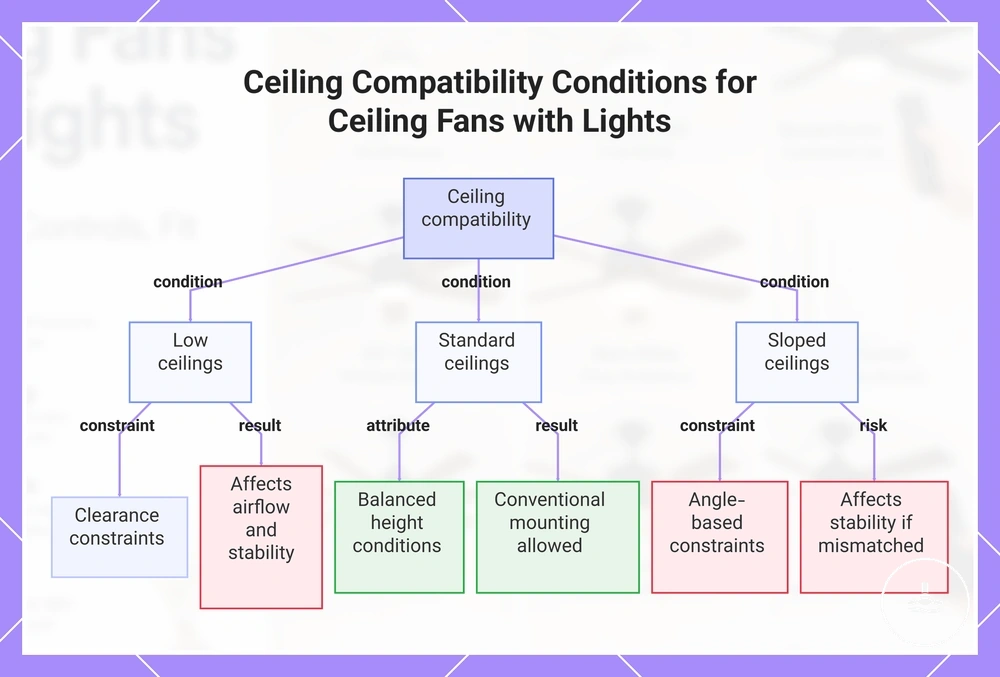
Ceiling compatibility factors determine whether a ceiling structure can support a ceiling fan with lights based on ceiling height, slope angle, and mounting constraints that influence clearance and stability. Compatibility depends on how the ceiling geometry interacts with structural limits, which affects both installation suitability and operational airflow consistency. The idea of low profile fit for ceiling fans with lights reflects how reduced ceiling height conditions require tighter clearance alignment to maintain safe operating space. Ceiling compatibility is therefore assessed through three conditions: low ceilings, standard ceilings, and sloped ceilings.
Low ceilings create clearance constraints where reduced vertical space can limit safe distance between the fan and surrounding surfaces, affecting airflow movement and stability conditions. Standard ceilings provide balanced height conditions that typically allow conventional mounting approaches without significant clearance restrictions, supporting more stable airflow behavior. Sloped ceilings introduce angle-based constraints where slope angle influences mounting compatibility and structural alignment, which can affect stability if not properly matched to the fixture design. Across all conditions, ceiling height, slope angle, and mounting limits define whether the system can operate within safe structural boundaries.
Safety considerations in ceiling compatibility focus on maintaining structural stability and sufficient clearance to reduce operational risk under different ceiling conditions. When ceiling height is low or slope angle is significant, installation suitability becomes more dependent on structural alignment and mounting compatibility to maintain stability during operation. Airflow effectiveness may also vary depending on how ceiling constraints influence circulation space and fan positioning. These constraints highlight the importance of matching ceiling structure with appropriate mounting configuration to maintain stable and consistent performance across different environments.
This chart shows the three ceiling conditions (low, standard, sloped) and their key constraints and outcomes for ceiling fan installation safety and performance.
Installation requirements and safety considerations for ceiling fans with integrated lighting
Installation requirements for ceiling fans with integrated lighting define the structural, electrical, and clearance conditions needed for safe system operation, based on mounting support strength, wiring readiness, and spatial safety constraints. These requirements determine whether the ceiling structure can properly support load distribution and maintain stable operation of both airflow and lighting systems. Installation requirements for ceiling fans with lights relate to how mounting integrity, wiring configuration, and clearance conditions must align before the system can function safely. Installation readiness is typically assessed through three constraint groups: structural support, electrical wiring, and clearance safety conditions.
Structural support depends on ceiling material strength and mounting hardware compatibility, which directly affects stability and load distribution during operation. Wiring readiness determines whether electrical connections can safely support integrated lighting functionality without introducing operational instability or inconsistency. Clearance conditions define the minimum safe space required around the unit to maintain airflow effectiveness and reduce contact risk with surrounding elements. These three factors form a constraint-based checklist where support strength influences stability, wiring influences functionality, and clearance influences operational safety across different installation environments.
Installation safety considerations focus on ensuring that structural load limits, wiring integrity, and clearance conditions collectively meet acceptable operational thresholds for consistent performance. When ceiling support is weak or wiring conditions are incomplete, installation suitability may be reduced and operational reliability can vary depending on configuration quality. Clearance limitations can also affect airflow distribution and increase operational risk if spatial boundaries are not adequately maintained. These factors highlight the importance of validating structural, electrical, and spatial conditions before confirming installation readiness in different environments.
| Installation Factor | Requirement Focus | Impact on Operation |
|---|---|---|
| Mounting support strength | Structural load capacity | Stability and safety of fixture |
| Wiring configuration | Electrical readiness | Lighting functionality and consistency |
| Clearance distance | Spatial safety limits | Airflow performance and operational safety |
| Hardware compatibility | Mounting alignment | Secure attachment and balance |
Cost and value factors influencing the selection of ceiling fans with lights
Cost and value factors influencing ceiling fans with lights depend on how efficiency, durability, and integrated feature quality interact with overall system design. Motor efficiency influences long-term operating cost behavior, while LED quality affects durability value through lighting consistency and lifespan variability. Control systems also shape value perception because more advanced configurations can increase usability complexity while improving functional flexibility. Installation complexity may also contribute indirectly to cost-value balance depending on structural and wiring conditions. These relationships form a tiered evaluation logic that typically separates budget, mid-range, and premium considerations.
The cost and value factors in ceiling fans with lights vary across budget, mid-range, and premium tiers, where each level reflects different balances between efficiency, durability, and control system capability. Budget options usually prioritize basic motor efficiency and simpler LED configurations, which can reduce upfront cost but may limit long-term feature consistency. Mid-range configurations often balance improved LED quality with better airflow efficiency and more stable control systems, creating moderate value stability over time. Premium options typically emphasize higher motor efficiency, advanced control integration, and more durable lighting systems that can improve long-term performance consistency under varied usage conditions. Across all tiers, perceived value depends on how well efficiency and durability align with intended usage needs rather than price alone.
| Tier | Efficiency Focus | Durability Level | Control System | Value Outcome |
|---|---|---|---|---|
| Budget | Basic motor efficiency | Standard LED quality | Simple controls | Lower upfront cost, limited feature depth |
| Mid-range | Balanced efficiency | Improved LED durability | Enhanced control options | Balanced performance and long-term usability |
| Premium | High motor efficiency | Advanced durability systems | Integrated smart controls | Higher long-term consistency and feature depth |
Decision-making around cost and value depends on aligning efficiency, durability, and control systems with expected usage intensity and environmental conditions. Higher investment levels may support improved operational consistency, but suitability still varies based on room requirements and installation context. Lower tiers may be sufficient in simpler environments where advanced control or extended durability is not essential. The overall value assessment therefore relies on balancing functional needs against system complexity rather than focusing on a single attribute. This framework leads into broader evaluation of feature integration and system performance trade-offs in subsequent considerations.