
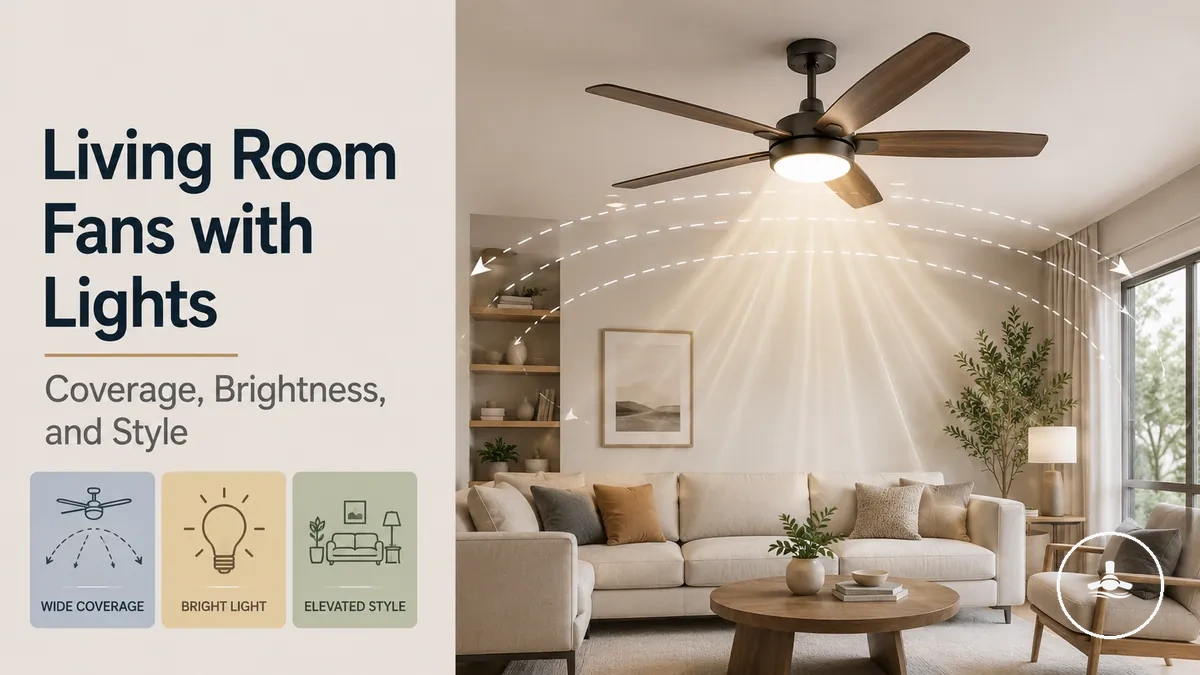
Ceiling Fans with Lights for Living Rooms: Coverage, Brightness, and Style
Ceiling fans with lights for living rooms are combined comfort and lighting fixtures used to support air movement, everyday visibility, and visual cohesion in a shared room. Their suitability depends on how room size, ceiling height, airflow coverage, lighting brightness, and design integration work together for living room comfort. A larger or more open living room may need broader circulation reach, while a smaller or lower-ceiling space may need a more restrained fit. Lighting output also matters because a living room can shift between relaxing, entertaining, reading, and general household use. Design integration affects whether the fan feels proportionate within the interior rather than visually heavy or disconnected. The right evaluation starts by treating airflow, lighting, and style as connected selection criteria instead of separate features.
A good living room ceiling fan with light is usually the one that balances comfort conditions with the room’s layout and daily use. No single factor determines fit on its own, because strong airflow may still feel unsuitable if the light is too harsh, the scale is wrong, or the design conflicts with the room. The following sections break the decision into practical layers: living room usage, airflow behavior, brightness and ambience, style fit, ceiling constraints, and final selection logic. Use those layers to compare options by need rather than assuming one configuration suits every living room.
Living room ceiling fans with lights: scope, use cases and performance expectations
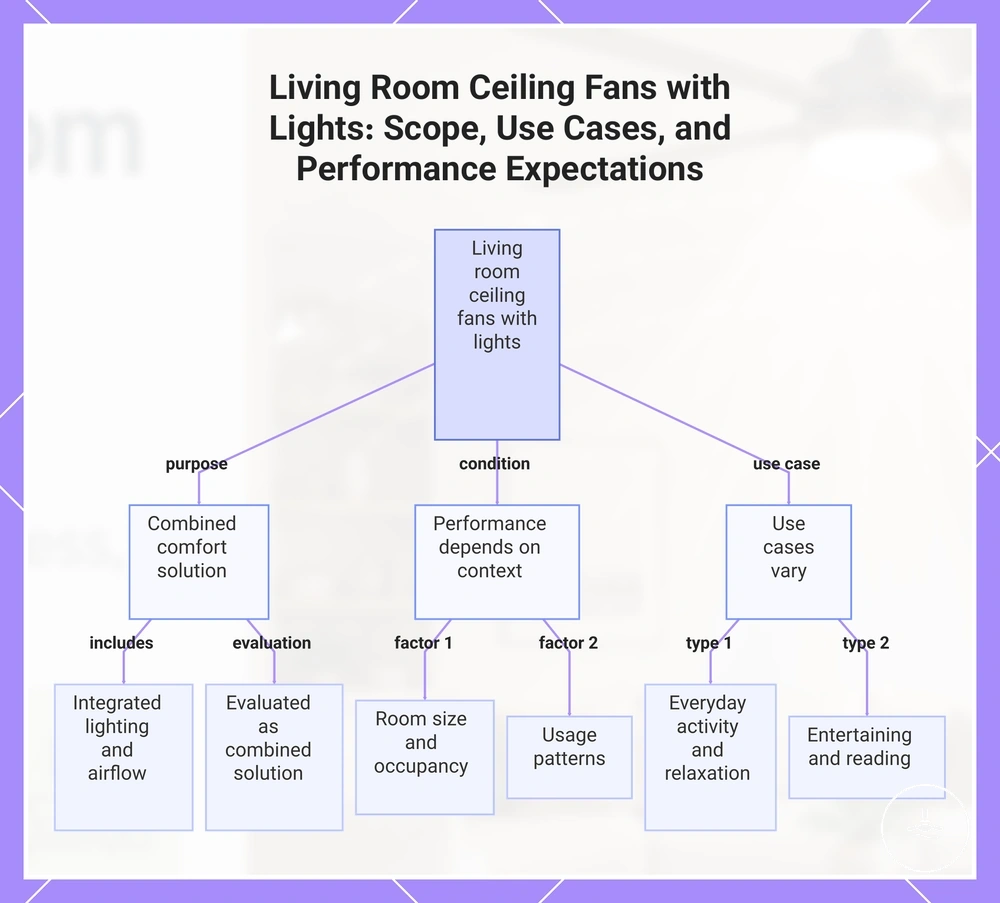
Ceiling fans with lights combine integrated lighting and airflow support in a single fixture for shared residential living spaces. Their ceiling fan function is to help circulate air while providing ambient lighting that supports everyday living room usage. These fixtures are intended to address both illumination and air movement within the same environment, so they are typically evaluated as a combined comfort solution. Performance expectations depend on room size, occupancy patterns, and how the space is used rather than assuming identical results in every living room.
Living room usage often changes throughout the day, making different use cases important when assessing a ceiling fan with integrated lighting. During everyday household activity, ambient lighting can provide general illumination while airflow support may contribute to a more comfortable indoor environment. Relaxation, reading, entertaining guests, or family gatherings can each benefit from different balances of circulation and lighting mood. Because these activities vary, the preferred combination of illumination and airflow may also change according to the occasion rather than remaining constant.
Performance expectations should be based on the living room's conditions instead of fixed assumptions. A ceiling fan with integrated lighting may feel more effective in one setting than another because comfort conditions depend on room layout, occupancy, and intended use. The following sections examine the individual considerations that influence airflow support, lighting performance, and overall selection for living room environments.
- Combines integrated lighting and airflow support in a single fixture.
- Supports everyday living, relaxation, and shared household activity.
- Comfort conditions vary according to room size, occupancy, and usage.
- Airflow and ambient lighting are most useful when evaluated together.
This chart shows the combined purpose, contextual performance factors, and typical use cases of ceiling fans with integrated lighting for living rooms.
Airflow and comfort coverage for living rooms and open-plan spaces
Airflow distribution influences comfort consistency by determining how air movement spreads throughout a living room. The relationship follows a connected pattern: fan capacity affects circulation reach, circulation reach shapes the distribution pattern, and that distribution influences perceived comfort consistency. The living room layout plays an important role because walls, openings, furniture, and connected areas can alter how air travels through the space. Airflow distribution should therefore be evaluated within the room itself rather than as a standalone characteristic. Considering these connected factors helps create realistic expectations for everyday comfort.
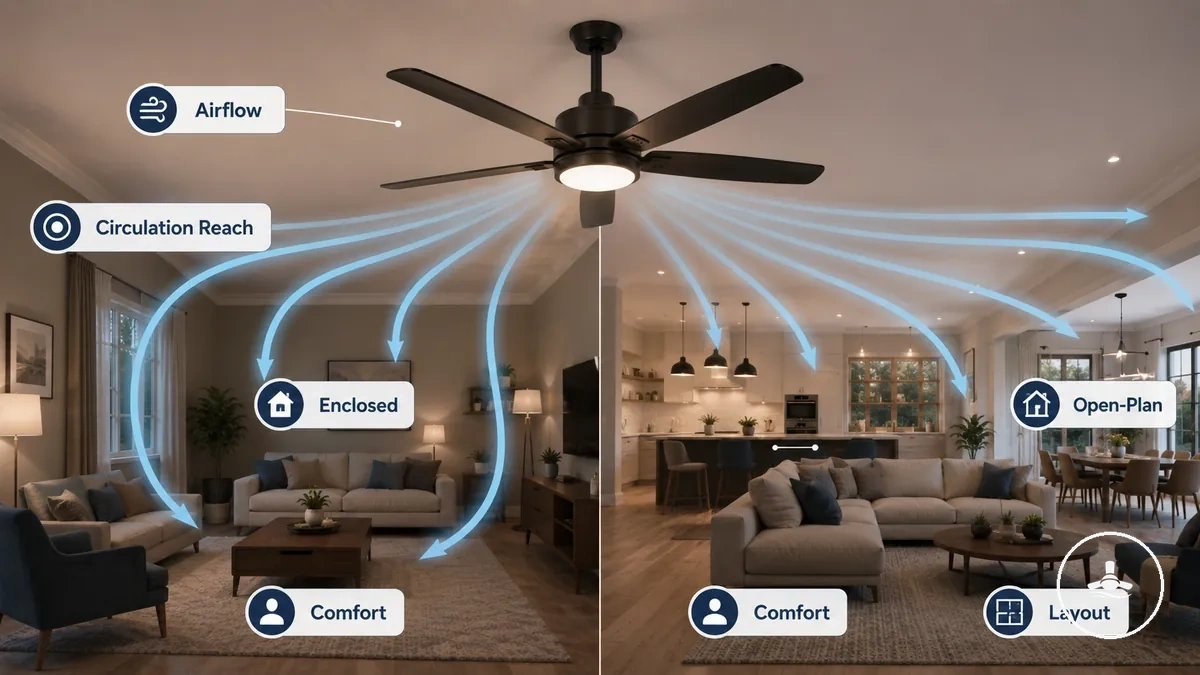
An enclosed living room is a more defined environment where air movement often remains within clearer physical boundaries. By contrast, an open-plan space allows airflow to continue into adjoining areas, which can change how circulation is perceived across the occupied zone. The same circulation reach may therefore produce different airflow distribution patterns depending on the living room layout. Open spaces can benefit from broader circulation, while enclosed rooms may experience a more concentrated airflow pattern. Neither layout is inherently better, as comfort consistency depends on how airflow interacts with the surrounding space. For additional guidance on circulation in larger connected areas, see airflow for larger rooms.
Circulation reach should be assessed according to the layout and intended use of the room rather than by fixed expectations. A circulation pattern that covers the occupied area more evenly may provide a more consistent perception of comfort, while uneven airflow distribution can leave different parts of the room feeling different. Because layout geometry influences how air movement spreads, comfort consistency varies with the characteristics of each living room or open-plan space. Evaluating airflow distribution in the context of the room helps support a more informed selection process.
Lighting brightness and ambience for everyday living room use
Integrated lighting shapes both functional visibility and the atmosphere of a living room. The relationship follows a practical sequence: brightness level influences the amount of light available, the resulting light affects the ambience, that ambience supports different activities, and the outcome contributes to visual comfort. Living room lighting is therefore best evaluated according to how it supports everyday use rather than by a fixed level of illumination. Colour temperature also influences how the space is perceived, creating different visual impressions for different situations. The most suitable combination depends on the room, the activity, and personal preference instead of a universal standard.
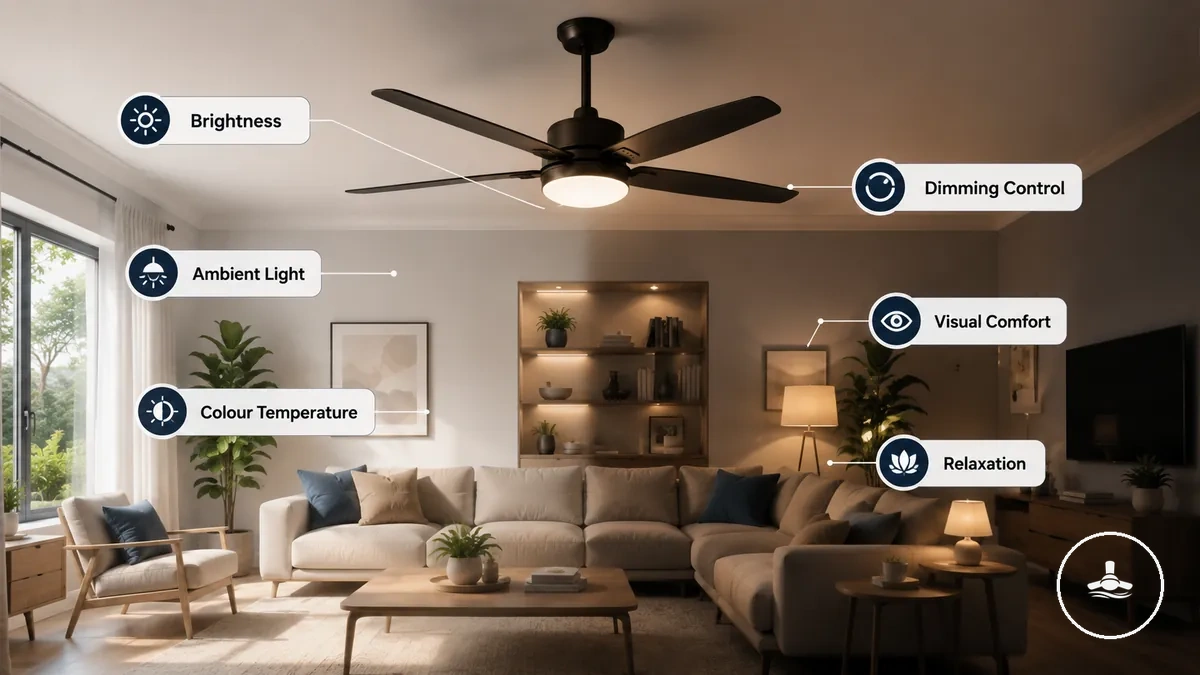
Different living room activities often benefit from different lighting conditions. A higher brightness level may be more appropriate for general household tasks or social gatherings where broader visibility is preferred. Softer ambient light can help create a more relaxed atmosphere for quiet evenings or entertainment. Colour temperature also influences mood, with warmer or cooler appearances changing how the room feels without defining a single correct choice. Dimming control provides flexibility by allowing living room lighting to adapt as activities change throughout the day. For additional guidance on brightness adjustment and dimming behaviour, see living room brightness planning.
Dimming control offers a practical way to adapt integrated lighting to changing needs throughout the day. Adjusting the brightness level can improve visual comfort for reading, relaxing, entertaining, or everyday household activities without relying on the same light output at all times. Because natural light, room finishes, and individual preferences differ, the most suitable setting also varies between living rooms. Considering brightness level, colour temperature, and dimming control together provides a more balanced approach to evaluating living room lighting than focusing on a single attribute alone.
- General household visibility
- Relaxation with ambient light
- Entertainment with adjustable lighting
- Flexible visual comfort through dimming control
Design and style integration for modern and decorative living rooms
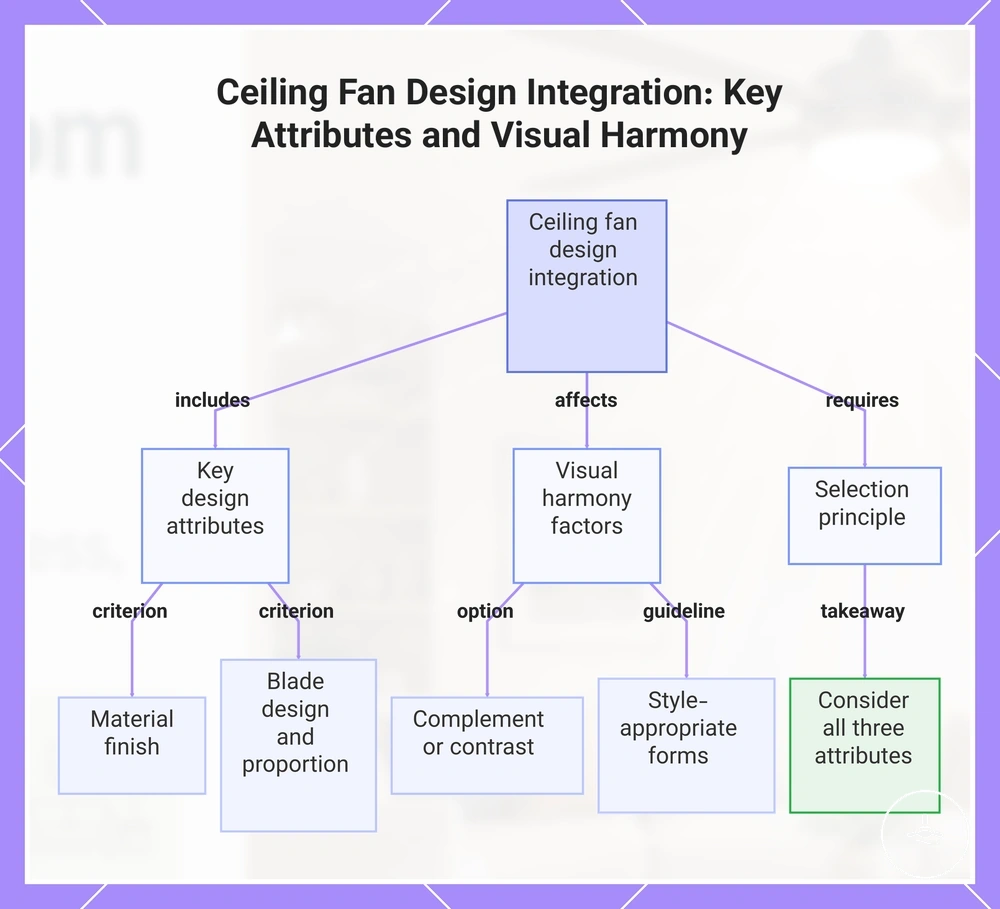
Design integration depends on how well a ceiling fan complements the existing interior style rather than standing apart from it. Design attributes such as material finish, blade design, and overall visual weight influence how naturally the fixture aligns with surrounding furnishings and architectural elements. That visual alignment contributes to visual harmony, which in turn affects the perceived fit within the living room. A ceiling fan that reflects the room's proportions, finishes, and decorative character can appear more cohesive without suggesting that one design style is universally preferable. Selecting a fan as a compatibility element rather than an isolated decorative feature supports a more balanced approach to living room aesthetics.
Material finish, blade design, and visual proportion are practical criteria for evaluating design integration. A material finish that complements existing furniture, lighting, or hardware can strengthen visual harmony, while a contrasting finish may also suit the interior style when it intentionally supports the overall décor. Blade design influences the visual weight of the fixture, making proportion an important consideration alongside room scale and layout. Modern interiors may suit cleaner forms with restrained detailing, while decorative living rooms may accommodate more expressive shapes or finishes when visual balance is maintained. Neither approach is inherently better because perceived fit depends on the relationship between design attributes and the surrounding space. Considering finish, blade form, and proportion together provides a more informed basis for selection. For broader selection guidance based on room priorities, see best ceiling fans with lights by priority.
This chart illustrates how material finish, blade design, and proportion influence visual harmony and how to select a ceiling fan as a compatibility element for modern and decorative living rooms.
Ceiling height, room layout and installation fit in living rooms
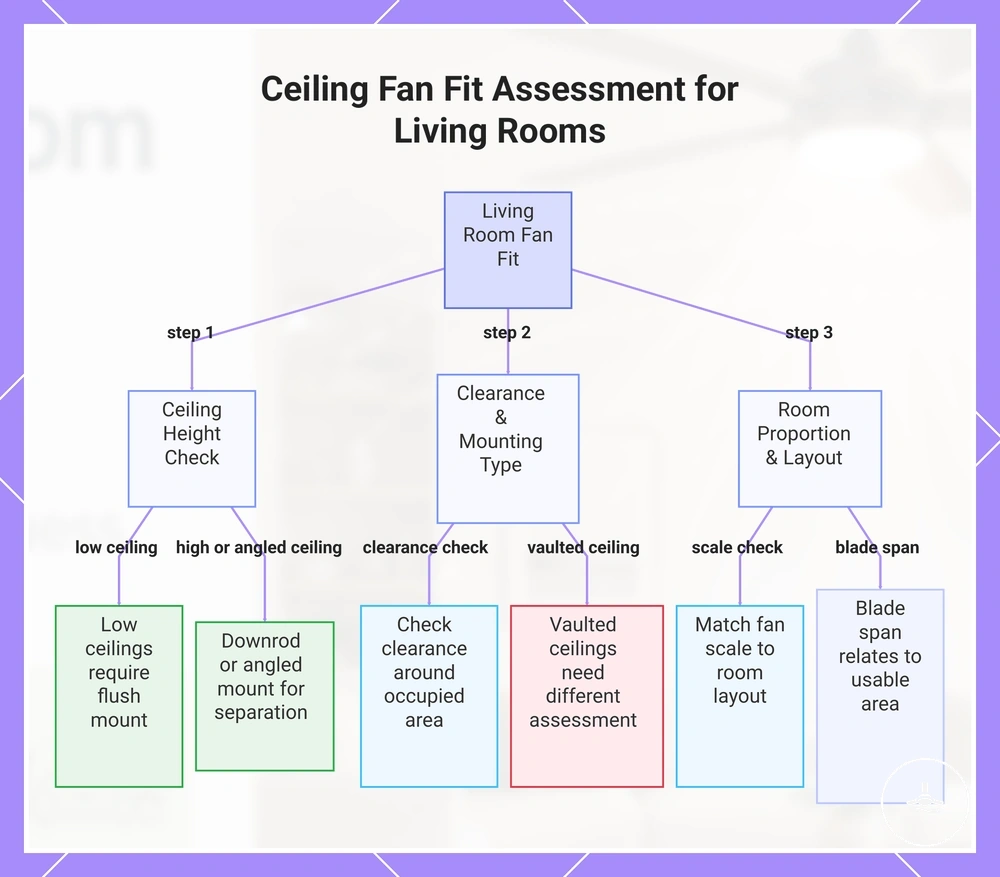
Ceiling height compatibility depends on whether the fan, light, and mounting approach can fit the living room safely and proportionally. A ceiling fan with light may need different clearance, mounting type, or spatial alignment depending on the room height and layout. Low ceilings may suit a closer mounting approach, while higher, angled, or more open spaces may require different fit considerations. Spatial layout also matters because furniture placement, walking paths, and the main occupied area influence whether the fan feels balanced in the room. Installation fit should therefore be assessed as a relationship between ceiling height, clearance, mounting type, and living room compatibility.
Clearance refers to the usable space around and below the fan, while mounting type describes how the fan is positioned against the ceiling structure. A flush mount may be more relevant where ceiling height is limited, while a downrod or angled mounting approach may be considered where the ceiling shape or height requires separation from the ceiling surface. The purpose is not to describe installation steps, but to understand how mounting configuration affects airflow, spacing, and comfort. A living room with a vaulted or angled ceiling may need a different assessment than a flat-ceiling room, so vaulted ceiling fan fit should be considered when the ceiling shape is part of the constraint. These fit decisions should remain conditional because suitability depends on the room structure and the specific fan configuration.
Proportional fit should be judged by matching ceiling height, room scale, and the main area where comfort is needed. A fan that appears too low, too large, or visually misaligned may affect both comfort perception and room balance. Blade span should also relate to the living room’s usable area, so room coverage and blade span can help connect size with layout. Before comparing styles or features, check whether the ceiling height supports the mounting type, whether clearance remains suitable, and whether the fan aligns with the room’s proportions.
- Check ceiling height before judging mounting type.
- Consider clearance around the occupied living area.
- Match fan scale to room layout and proportion.
- Use angled or vaulted ceiling guidance when ceiling shape affects fit.
This chart shows three key checks to evaluate whether a ceiling fan with light fits a living room based on ceiling height, clearance, mounting type, and room proportion.
Choosing the right ceiling fan with light for your living room
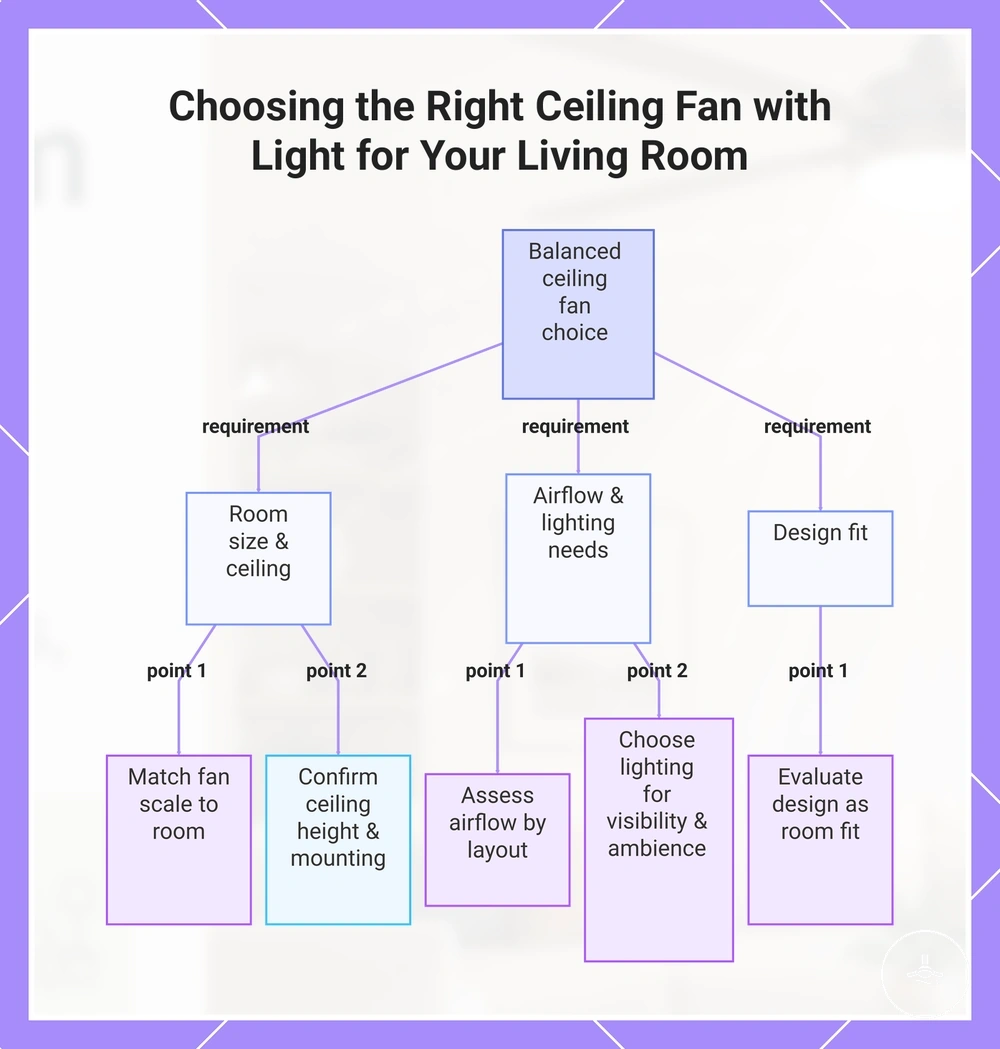
A decision framework for choosing a ceiling fan with light depends on balancing airflow needs, lighting needs, room size, ceiling constraints, and overall living room fit instead of prioritising a single feature. Each selection criterion contributes to compatibility, so the most suitable option is determined by how these factors work together within the room. A larger living room may place greater emphasis on airflow coverage, while a more compact space may depend more on proportional sizing and installation fit. Lighting needs also vary according to everyday activities, relaxation, and entertaining, making flexibility an important consideration. Evaluating these trade-offs together supports a more consistent selection process than focusing on one attribute alone. For broader category guidance, see ceiling fans with lights.
Selection criteria are most effective when evaluated as connected decisions rather than separate features. Room size influences the appropriate scale of the fan, while airflow needs should correspond with the layout and the areas where comfort is expected. Lighting needs should reflect the intended balance between general visibility and ambient atmosphere. Ceiling constraints, including height and mounting compatibility, determine whether a particular configuration is appropriate for the available space. Design should complement the room without outweighing practical considerations such as proportion, placement, and compatibility. A balanced evaluation framework usually provides a more suitable outcome than attempting to optimise a single characteristic.
- Match room size with an appropriate fan scale.
- Assess airflow needs according to room layout and daily use.
- Choose lighting needs that support both visibility and ambience.
- Confirm ceiling constraints and installation fit before comparing designs.
- Evaluate design as part of overall living room fit rather than a standalone preference.
Final selection depends on how the room's conditions influence the overall balance between size, airflow, lighting, and compatibility. An open-plan layout, a compact living room, or a decorative interior may each change which selection criteria carry greater weight. Reviewing the checklist as a complete decision framework helps keep every factor in context and supports a ceiling fan with light that aligns more closely with the living room's overall requirements.
This chart visualizes the key selection criteria and balanced checklist for choosing a ceiling fan with light in a living room.
Standard living rooms vs open-plan living areas airflow behavior
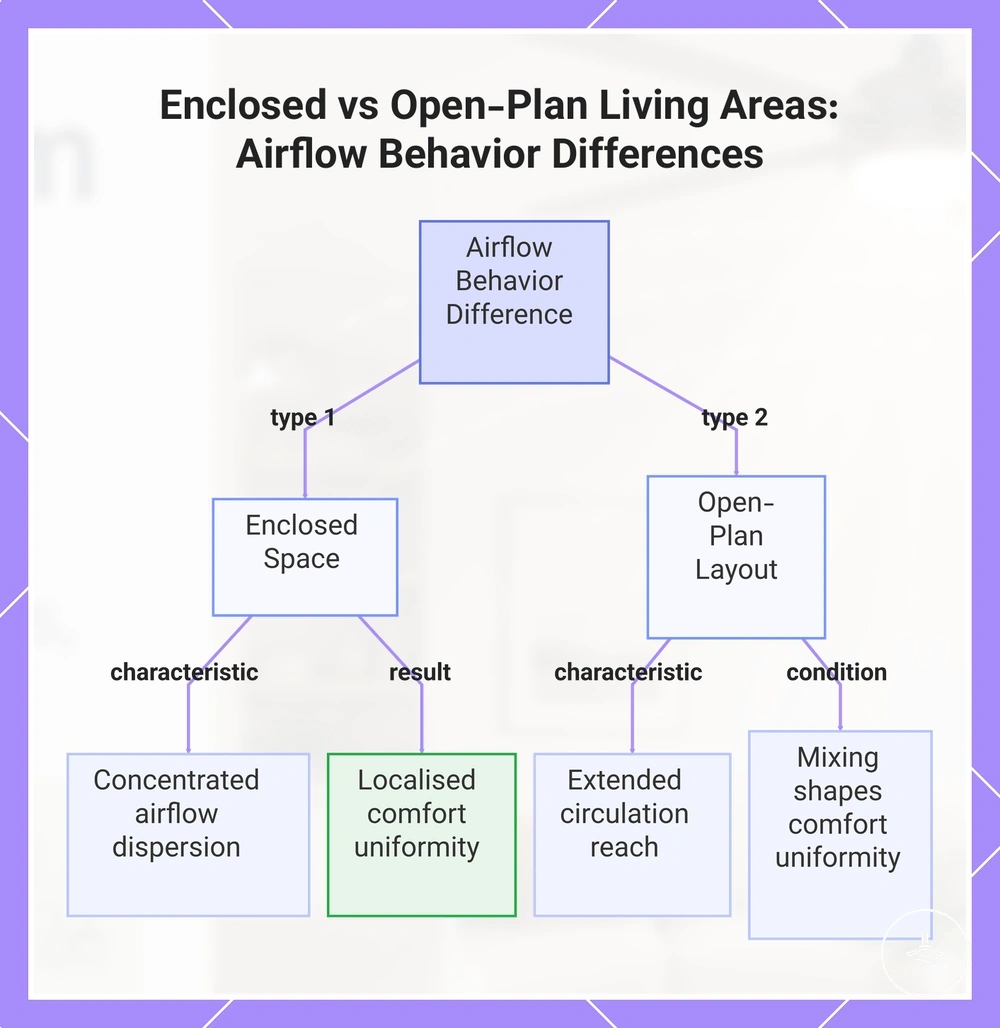
Airflow dispersion differs between an enclosed space and an open-plan layout because room configuration influences how air movement spreads and mixes throughout the occupied area. In an enclosed space, walls define the circulation area, allowing airflow to remain more concentrated within the living room. An open-plan layout allows air movement to extend into connected spaces, so circulation reach is distributed across a broader area. As airflow spreads over a larger layout, comfort uniformity depends on how effectively air movement mixes throughout the connected space. The layout therefore influences airflow behavior without making either configuration inherently superior.
Enclosed space: Airflow dispersion is generally more contained, allowing circulation reach to remain focused within defined boundaries and supporting more localised comfort uniformity.
Open-plan layout: Airflow dispersion extends into adjoining areas, increasing circulation reach across a broader configuration and changing how air mixing occurs throughout the space. Because air movement is shared between connected zones rather than confined to a single room, comfort uniformity depends on how airflow spreads across the overall layout. The resulting airflow behaviour is shaped by the structure and configuration of the living area rather than the layout type alone.
This chart compares airflow dispersion, circulation reach, and comfort uniformity in enclosed living rooms versus open-plan layouts.
Sizing priorities for small, medium and large living rooms
Sizing logic maps room size and spatial volume to a blade span that remains proportionate to the living room while supporting appropriate airflow coverage. Rather than selecting the largest available fan, the objective is to maintain a balanced relationship between fan size, room scale, and overall fit. As room size increases, a larger blade span may become more suitable for the available space. Spatial volume can also influence proportional fit because the fan should complement the room instead of appearing undersized or oversized. Applying sizing logic as a proportional evaluation supports more consistent comfort stability without relying on fixed sizing assumptions.
Use the following proportional guide when comparing living room layouts. For additional guidance on proportional alignment, see room coverage and blade span.
- Small living rooms: A compact blade span may provide a proportionate fit for the available room size and spatial volume while maintaining suitable airflow coverage.
- Medium living rooms: A moderate blade span often provides a balanced relationship between room dimensions, airflow coverage, and overall fan proportion.
- Large living rooms: A broader blade span may better align with greater spatial volume and a larger occupied area, provided the fan remains proportionate to the room.
Balancing airflow performance and lighting requirements for living room comfort
Comfort balance depends on evaluating airflow intensity and lighting output together according to living room use rather than prioritising one over the other. Higher airflow intensity may be more appropriate when stronger air circulation is the primary objective, while greater lighting output may be more suitable when visibility is the main requirement. The preferred balance changes with the intended usage scenario, so no single combination is ideal for every living room. Energy efficiency should also be considered because both airflow and lighting contribute to overall energy consumption. Evaluating these trade-offs helps support comfortable everyday use without relying on fixed performance targets.
Trade-off evaluation: Airflow intensity should be assessed alongside lighting output to achieve an appropriate comfort balance for the intended activity. Living room use for relaxation may favour a different combination than reading, entertaining, or general household tasks. Energy efficiency is another evaluation factor because the preferred balance depends on how often and how long both functions are used together. Rather than maximising circulation strength or brightness level independently, compare how each contributes to the intended comfort outcome. For additional guidance on lighting evaluation, see living room brightness planning.
- Match airflow intensity with the lighting output needed for the activity.
- Consider energy efficiency alongside comfort balance during evaluation.
- Adjust the airflow and lighting trade-off according to changing living room use.